Synopsis
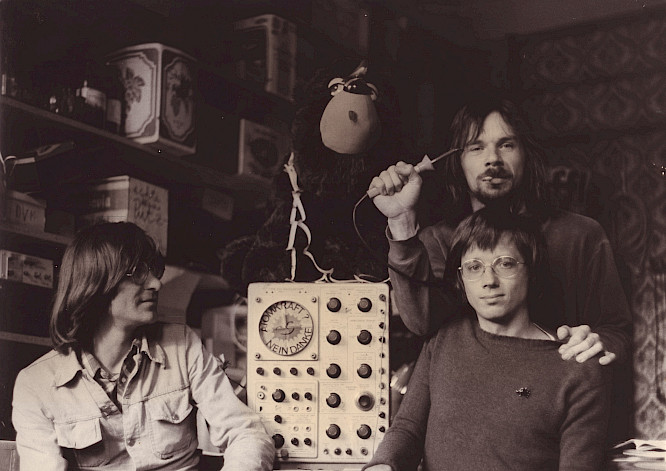
Reiner wanted to do things differently. Both in respect of his political principles and his technical work he wanted to go beyond conventional practices. In 1970, at the age of 21, he enrolled at Berlin’s Technical University to study aerospace. In 1978 with two like-minded male colleagues he founded the socialist engineering collective “Wuseltronick” in an old apartment building in Berlin-Moabit. They intended to find out if it was possible to develop small scale, effective production practices outside the parameters of traditional capitalist manufacture. The collective became their family, and they described their work practises as democratic in that they were exhaustive discussions as to which projects should be undertaken. However despite hard work, they made little money. But for Reiner, who despised making money for its own sake, that was not important . It was enough for him to realise his own idea of fusing life and work. It was therefore fortunate that his girl-friend and later wife, Anne, earned enough as a doctor to support the family. The collective’s motto became: “To hell with profit. Let’s do something worthwhile” and it was carried through with red wine, cigarettes and lots of music. “Worthwhile” always meant improving the quality of life, for instance through enhancing the viability of wind and solar power systems. Their overriding aim, which they pursued over a 10 year period, was to remain independent of big companies and to stay clear of nuclear power. In their workshop they developed several practical wind generators, although it was above all the manufacture of measuring instruments for wind classification that kept their heads above water. Nonetheless it was clear to Reiner that it would not be enough merely to develop devices for future wind and sun energy supply. They would also need to manufacture and market them on a large scale. This led to long and occasionally divisive discussions about the identity and goals of the collective. Ultimately collective work broke down as they realised that they were not able to achieve cost effective mass production of solar modules- and certainly not of solar cells- by remaining true to their original principles. A further unsettling factor was the appearance of women in the collective, whether as collegues or partners. The women placed greater emphasis on financial resources adequate to both a normal life and to the demands of starting family. As a result, Reiner decided to accept mass production while trying to hold onto his socialist ideals. In 1996 he and friends in Berlin established the firm SOLON, with was immediatlely and successfully put on the stock market. It manufactured solar modules and initially did very well. But Reiner continued to think ahead. He was very attracted by the idea of manufacturing his own solar cells. However it was not possible to expand the firm in Berlin. As a result, in 1999 they began solar cell production in Thalheim in the Federal State of Sachsen-Anhalt. This turned out be an ideal fusion of concept and capital (although Reiner had always despised the latter) and grew into the public trading company firm Q-cells at a time when there was a worldwide drive to become independent of oil. In 2005 Reiner was voted entrepreneur of the year. For several years Reiner lived with a brain tumour. Nevertheless, despite the strain of treatment he continued to work inexhaustibly, making fresh plans and establising a foundation to encourage the development of new energy resources. In December 2006 he died at the height of his success.