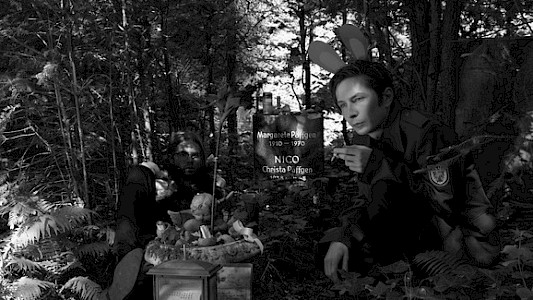
Germany 2020, 45 minby Stanislav Danylyshyn
In western Ukraine is located one of the largest Roma settlements in the country - the place is called Tábor. An isolated quarter of the city of Berehove, where live mostly Hungarian speaking Romani people. The film shows one of the days of the celebration of Easter, when the boys water the girls, receiving Easter eggs for this. After the end of the holiday many of them leave the settlement with their entire families and go to roam the country. The film reflects human being in a timeless dimension, brings closer archetypal images: mother, father, child. Depicts the plasticity of the movement of a man and nature in the space, which they are being a part of, creating chaos that contains a balance between different components like light and shadow. (dffb)
Tábor
Germany, Austria 2014, 55 minby Georg Tiller
DMD KIU LIDT is an anti-music film which follows the Austrian pop-rock band Ja, Panik and their social circle of fellow musicians in Berlin and Vienna. It is a chronicle of a group that centers on the conditions of music-making in a state of prolonged sadness dominated by the shadow of a permanent crisis (of capitalism). The actors - all musicians - play themselves, acting out a consciously absurd drama about art, depression and love. JA, PANIK created quite a stir in the German-lanugage music scene with their three consecutively released albums: The Taste and the Money (2006), The Angst and the Money (2009) and DMD KIU LIDT (2011). Unanimously celebrated, they have been named one of the most important bands working in the German-speaking music world today. The group's cheerful use of a specific kind of bricolage, which pieces together a broad spectrum of literary and theoretical allusions: from Walter Benjamin, over John Cage to Bertolt Brecht, forms their sound and lyrics. Along with fellow musicians Christiane Rösinger (former Lassie Singers), Hans Unstern, Jens Friebe, Maurice Summen and Chris Imler, they represent a singular force in contemporary German music. The anti-music film DMD KIU LIDT aims not only to be a chronicle of this very talented group of musicians, but also to create a filmic equivalent to the German term diskurspop (discourse pop). The term loosely describes a music that desires to be a serious and accessible expression of (post-)pop, while it is conscious of being a result of theoretical, literary and social discourse.
DMD KIU LIDT
Bitte aktivieren Sie Javascript, um auf unsere Website zugreifen zu können.