Germany, Austria 2019, 218 minby Thomas Heise
The film picks up the biographical pieces of a family torn apart through the end of the 19th and into the 20th century.The used material is what remained of Thomas Heise’s family.It is about people who by chance found each other, only then to lose each other.Now it is their descendants, their children and grandchildren who are beginning to disappear.Fathers and mothers, sons and brothers, the affairs, the hurt and the joy in landscapes of transition – each bearing the intertwining, hallmarks of their times. A collage of images, sounds, letters, diaries, notes, voices, fragments of time and space.
Heimat is a Space in Time
Germany 2014, 83 minby Thomas Heise
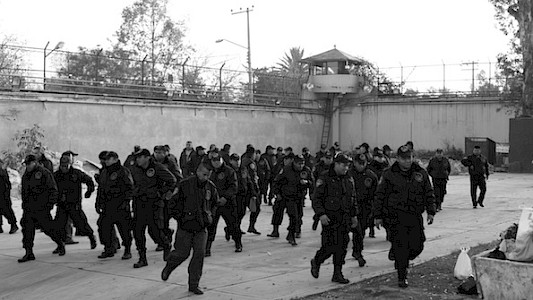
The beginning shows a dusty landscape somewhere on the outskirts of the city accompanied by a poem from 1921, written by Bertold Brecht and spoken by a young woman. It is about the disappearence of a man, how waiting for him fades and eventually the memory there of. 'Städtebewohner' tells the story of everyday life in the „Comunidad San Fernando“, a prison in Mexico City. About 200 prisoners are currently living here, offenders who were sentenced as juveniles for a maximum of 5 years to San Fernando in order to leave it as men not older than in the age of 23. In quiet observations the film portrays the life of the residents of San Fernando. It is December. We get to know 3 of those 200 better. There are Samuel and Ever, still children when they were judged guilty of murder. "It's complicated but I didn't do it" says Samuel. "Now I'm in here." "I shot him in the head", Ever says, and what does his glance say when adding "I was 14". And there is Irving, who was a robber and fears the outside, his liberty, when spring will come. On the afternoon of Christmas Eve his father explains him where to aim accurately in order to best shoot someone dead. Life is selfexplanatory. People act just as they are pleased to do. Encountering people around here is a constant jittering change between closeness and distance, as is the city where the prison is located. Encountering someone around here is a constant and edgy changing between closeness and distance. As is the city where the prison is at. Who is talking of stones?
STÄDTEBEWOHNER
Germany 2012, 65 minby Thomas Heise
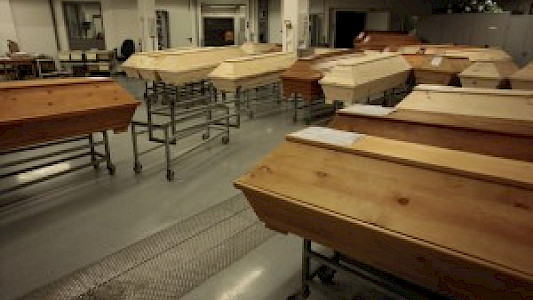
CONSEQUENCE follows the tiring working day between Christmas Eve and New Year at a small crematorium operating 24/7. This medium-sized business guarantees to deal with a dead body within three days - ensuring reliable planning for undertakers. So those left behind have the chance to quickly get back to their own productive everyday lives. Swift cremation helps the affected cope with bereavement quickly, says the company brochure. There’s a lot to be done. “It’s the economy, stupid!” In pictures without words CONSEQUENCE tells the story of what happens to us.
CONSEQUENCE - GEGENWART
2012, 74 minby Thomas Heise
Pope Benedict XVI, born Joseph Aloisius Ratzinger, is the 265th Pope. On his first official visit in his native Germany as the sovereign of the Vatican City State and the leader of the Catholic Church, all official media are concentrated on this unique event. But in Thomas Heise's film we do not get to see any of the official pictures. What we see is how the machine of the state exercising its control functions. (visionsdureel)The motorway has been shut. Mobile fences dissect the landscape. Helicopters keep abreast of the situation above maize fields and freshly ploughed farmland. Rows of portable toilets line the edge of the forest; others are grouped in compact, rectangular units out on the fields. Police stand in front. Helicopter landing pads have been set up, roads laid across the countryside, broadcasting towers erected and containers stacked on top of each other. Stages are being constructed; police cadets march to and fro. Down on the red carpet, the minister president and her husband are being assisted with their rehearsal in front of a gangway which leads into nothingness, while the motorcade rehearses the VIPs’ journey through the closed-off city. The state secretary is showing flower children what to do. Helicopters 1-6 are ready. What's happening?The German word LAGE (English: position, situation) comes from Middle High German and describes a 'position of lying in wait'. Something is going on. This may be 'a military, police or security situation: the situation of a military group in relation to their surroundings. A comprehensive view of the threat of government bodies or the reduction of domestic security. A situation which requires the police to act, factors and circumstances for rescue services which describe damaging events and damage prevention.'(source: Wikipedia)The film DIE LAGE tells of the very same, when in September 2011 Pope Benedict XVI travelled to Germany as part of his plan to promote New Evangelisation, paying visits to the city of Erfurt and a site in the Eichsfeld region, both in Thuringia. The situation there is as one might expect.A few weeks later at St. Peter's Basilica, the Pope announces his decision to declare a 'Year of Faith', to begin on 11 October 2012. "This will be a good opportunity to usher the whole Church into a time of particular reflection and rediscovery of the faith."DIE LAGE is the third in Thomas Heise's series of documentaries dealing with everyday life in Germany, after DAS HAUS (1984) and VOLKSPOLIZEI (1985). Take a peek behind the cordon.
CONDITION
Germany 2011, 100 minby Thomas Heise
SOLAR SYSTEM is a film about disappearance, about some people of the indigenous community of the Kollas of Tinkunaku, a region in the North of the province Salta, part of the district Orán, Argentina. Non-verbally, exclusively through images the film approaches the people of a small indigenous Kolla community. We accompany the seasonal tramp of Viviano and Ramona from the valley up to the village of Santa Cruz, 3000 meters above sea level, where they spend the summertime until the autumn rain makes them go back to Rio Blanquito. Living with the Kollas, in between the old rites and the irruptive modernity, in the grandiose landscape of Yunga and Quechua, the film tells the story of the day-to-day disappearance of an indigenous group. Dies irae.
SOLAR SYSTEM
Germany 2009, 166 minby Thomas Heise
Something always remains, a rest, that cannot be subsumed. (From EISENZEIT 1991) The Film MATERIAL contains observations, scenes, fragments, stories and processes. Images from the late eighties in the GDR to the immediate present of the year 2008 in Germany. The montage of these images creates a picture of these times, where past, present and future mirror one another. It is my picture. In 1987 author Heiner Müller brought me a video camera back from West Berlin and I began using it to record images. Observations from the theatre and small scenes from the everyday reality of a disappearing state. Early 1990 this state was finished, all tapes were full and the camera was broken. Other cameras have sporadically taken its place. A Super 8, a 16mm and a 35mm camera, a DigiBetacam, and a DV-camera. The images from these cameras were produced to the left and to the right of the films I have made since then. Some of these excursions became part of these films, while others were never used. Ever since, those leftover images have besieged my head, constantly reassembling themselves into new shapes that are further and further removed from their original meaning and function. They remain in motion. They become history; they become a story. Now is the time to tell it. This film is not a polished end product; it is told from a very personal point of view. It shows what I saw, what caught my attention and what I held on to. It tells the story of a lot of people that start talking for the first time. And often only for that one time, after a long period of waiting and silence. A rare and often unexpected moment. Like a short awakening. I become aware that I am one of those people.original German version with English subtitles available
MATERIAL
Bitte aktivieren Sie Javascript, um auf unsere Website zugreifen zu können.