Germany 2019, 52 minby David Bernet
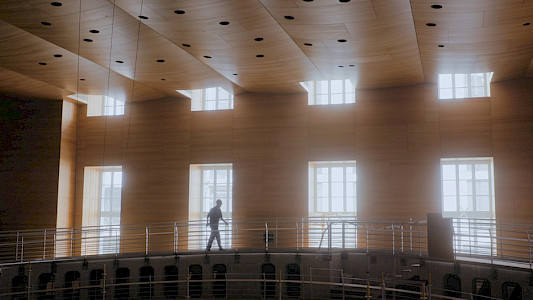
The inauguration of the Barenboim-Said academy in Berlin marked a new phase within the political and educational engagement of musician and pedagogue Daniel Barenboim. BEYOND THE MUSIC portrays this innovative academy whose mission it is to unite humanistic ideals, music and philosophy. Almost 20 years after the founding of the West-Eastern-Divan orchestra, another project of intercultural understanding is derived from the friendship between Barenboim and the Palestinian humanist Edward Said.
Beyond the Music - Barenboim-Said Academy
Germany 2018, 84 minby Martin Baer, Claus Wischmann
Who owns the image(s) of the world? We take more photographs in a single day than we did in the entire twentieth century. Our world transforms itself into its own image. It would be illegal if we were to show you everything we see around us. Because every single image is owned by someone.Copyright-owners of objects, buildings, trademarks and even landscapes claim money for the depiction of their property. The real moneymaker is the wealth of pictures of us all. Who do the pictures of ourselves a
The Illegal Film
Germany, Netherlands 2017, 90 minby Karin Jurschick
Shortly after 9/11, the US Congress passed a law to protect US airlines from decades of civil law suits and created a fund for compensating victims of disasters who agreed not to sue. Lawyer and mediator Ken Feinberg had to decide how much money was to be received as compensation. He met family members personally doing thousands of interviews. He thought that the value of a life was an easy calculation: how high is the economic loss? How old was the person, but Feinberg discovered that facing th
PLAYING GOD
Germany 2016, 90 minby Lutz Gregor
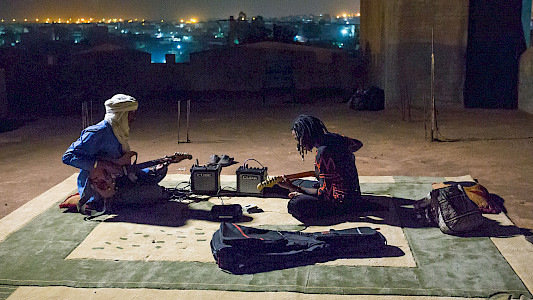
MALI BLUES tells the story of four female and male musicians from the West African country of Mali, who espouse with their music a tolerant Islam and a country at peace.The West African country of Mali is considered the birthplace of the blues and jazz, brought later by abducted slaves to America’s cotton fields. For centuries music has strengthened Mali’s cultural identity, musicians are holding strong positions in society. Following Fatoumata Diawara, shooting star of the global pop scene, MAL
Mali Blues
Germany 2012, 106 minby Philip Scheffner
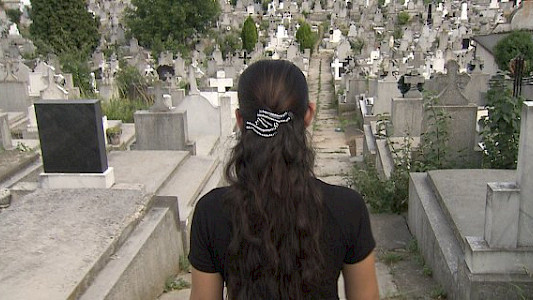
On June 29th, 1992 a farmer discovers two bodies in a corn field in the North East of Germany. Police enqiries lead to the fact that the dead men are Romanian citizens. During the attempt to cross the EU border, they have been shot by hunters. The hunters claim that they had mistaken the people for wild boar. Four years later, the trial begins. It will never be proved, which of the hunters has fired the fatal bullet. The verdict: not guilty. German Press Agency dpa reports: 'From Romania, noone
REVISION
Germany 2010, 95 minby Martin Baer, Claus Wischmann
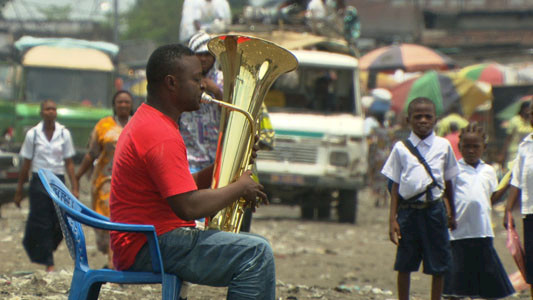
"Kinshasa Symphony" shows how people living in one of the most chaotic cities and one of the poorest countries in the world have managed to forge one of the most complex systems of human cooperation ever invented: a symphony orchestra. It is a film about the Congo, about the people of Kinshasa and about music. In the fifteen years of its existence, the Orchestre Symphonique Kimbanguiste has survived two violent coups d'état and an ongoing war that has claimed the lives of several million people.
KINSHASA SYMPHONY
Germany 2010, 100 minby Philip Scheffner
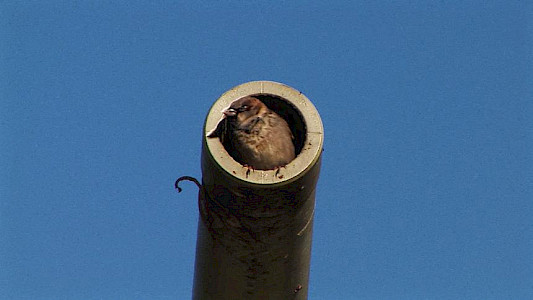
DAY OF THE SPARROW is a political wildlife documentary. It tells the story of a country where theborder between war and peace is disappearing. On November 14th , 2005 a sparrow is shot dead in Leeuwarden, and in Kabul a German soldier dies. These competing headlines are the starting point for director Philip Scheffner, to trace the war using the methods of an ornithologist. On his journey through Germany, the camera circuits a reality of the war – by capturing images of apparent peace.Dialogue
THE DAY OF THE SPARROW
You can contribute updates for the current person (Pascal Capitolin).
Bitte aktivieren Sie Javascript, um auf unsere Website zugreifen zu können.