Germany 2020, 83 minby Roswitha Ziegler (Wendländische Filmkooperative)
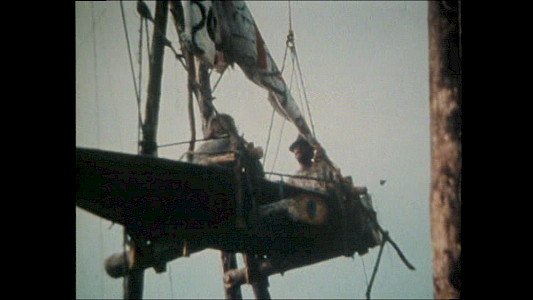
33 days of utopia is a film about remembering, digging up stories/history.In May 1980, more than 800 people lived for 33 days near Gorleben in the protest camp "Free Republic of Wendland" and thus prevented for a short time drilling for the planned nuclear waste repository in the nearby salt dome.Attila Dészi, archaeologist, Univ. Hamburg, made excavations at the protest camp 2017-2018. Digging for the history of the resistance, so to speak. What was the archaeologist looking for? What did he f
33 days of utopia
Germany 2017, 90 minby Niels-Christian Bolbrinker, Thomas Tielsch
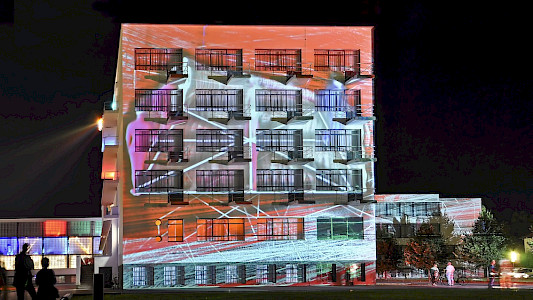
The film describes the fascinating story of the Bauhaus as statement, failure and renewal of a social utopia. And it tells of artists, scientists and architects today, who, in their examinations of current challenges also relate to the Bauhaus. That way, the story of this unfinished utopian project with its manifold exciting cross-references unfolds before our eyes while always keeping in touch with the questions still topical today: How do we want to live, where do we want to go?
Bauhaus Spirit
Germany 2013, 85 minby Niels-Christian Bolbrinker
Ever since radio and television were invented, paranoid people have been startling us with their detailed descriptions of imaginary technical apparatus, which, according to their theories, is being employed for surveillance and manipulation purposes. At the same time, however, this kind of technology was, in fact, being researched and built. This film is about the interplay between madness and method.
REALITY CHECK
Germany 2012, 27 minby Niels-Christian Bolbrinker
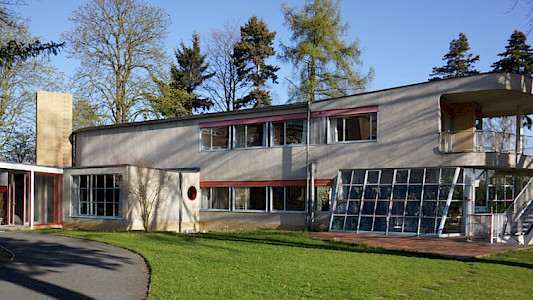
In the small town of Löbau in Saxony, tucked away behind a closed-down factory, lies one of the most striking houses of architectural modernism, the Schminke house. It was built from 1930 till 1933 by the architect Hans Scharoun for the noodle manufacturer Fritz Schminke and his familiy. Here, shortly before the Nazi years began, a world class architectural monument was created, a house full of light and open spaces, which the people from the town called the “noodle steamship”, owing to the many
BUILT WITH LIGHT
Germany 2011, 25 minby Niels-Christian Bolbrinker
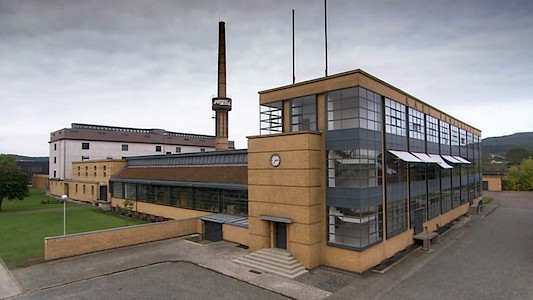
In 1911, in the small industrial town of Alfeld in Lower Saxony, work begun on the seminal building of modern architecture. The owner was Carl Benscheidt, an adherent of social and ethical ideals of that time, his architect Walter Gropius, who later founded the ‘Bauhaus’.Their project was the ‘Fagus’ workplace, which produced shoe lasts. True to his motto ‘Build palaces for the workplace’ Gropius designed a building which not only had an ultra modern exterior, but also exemplary working conditio
Fagus
Germany 2009, 93 minby Vadim Jendreyko
Swetlana Geier is considered the greatest translator of Russian literature into German. She has just concluded her lifework for Zurich’s Ammann publishing house - completing new translations Dostoyevsky’s five great novels - known as the five elephants. Her work is characterised by a great and sensual feeling for language and an uncompromising respect for the writers she translates. Her life has been overshadowed by Europe’s varied history. Together with the film director, the eighty-five-year
THE WOMAN WITH THE FIVE ELEPHANTS
Germany 2008, 80 minby Niels-Christian Bolbrinker
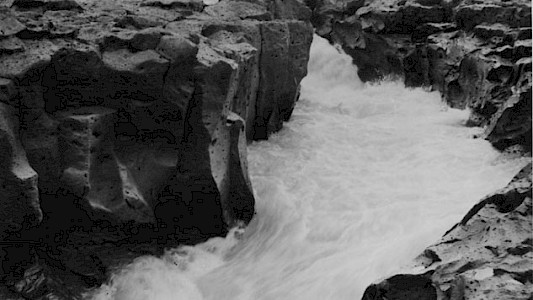
In the summer of 1938, German painter and landscape photographer Alfred Ehrhardt and his wife Lotte travelled to Iceland. Ehrhardt, a former Bauhaus student and one of the most important of the New Objectivity photographers, was looking for artistic form in nature and the fundamental forms of art. The film follows Ehrhardt's expeditions to Iceland, the Mudflats and the Curonian Spit and uses his wonderful photographs to address the question posed by Cees Noteboom: "Something in nature, and not b
NATURE BEFORE US
Germany 2008, 59 minby Thomas Tielsch
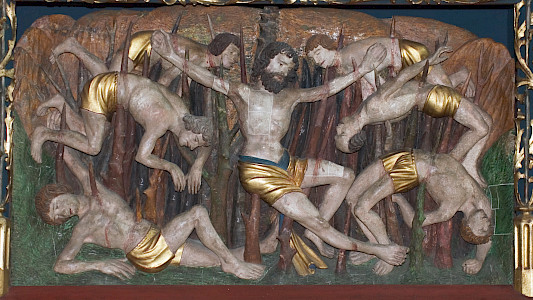
Nobody had expected his return. Still, in the face of the world publicity, he steps out from the dark of his past on September 11th in 2001. Since then, he has been back: the martyr. His history reaches far back into the ancient world, but only in Christ, he gets a face. By now the martyr has become a figure of many faces and shows up wherever conflicts are smouldering. Human sacrifices, massacres, mass suicides, tortures; Nuns whose asceticism is flooded by erotic fantasies. The film shows hist
DOWN TO THE BONE
Germany 2008, 92 minby Niels-Christian Bolbrinker, Dr. Kerstin Stutterheim
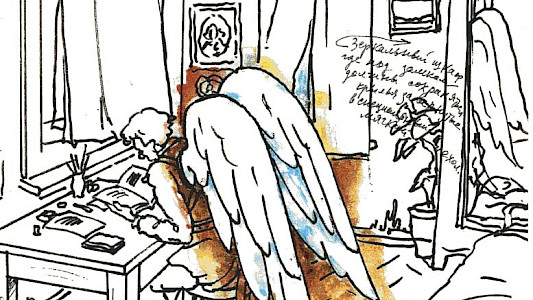
Ilya Kabakov was born in the Ukraine in 1933. Today he is considered one of the most important contemporary artists worldwide, and there is practically no significant museum of contemporary art around the world that doesn't show at least one of his installations. With his etchings, paintings and particularly with these installations he has for decades now created a phantastic world that serves as a counterpoint to the brutal reality and its many failed visions. These installations, executed with
FLIES AND ANGELS
Germany 2005, 75 minby Niels-Christian Bolbrinker
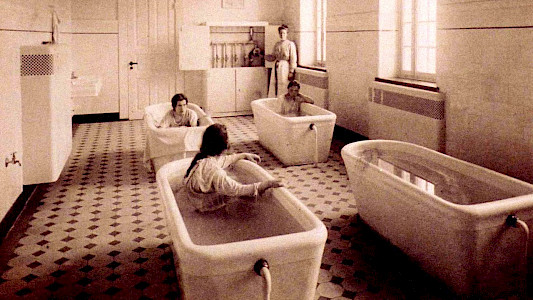
"Twice in her life, my mother sank into a deep depression: once in the early fifties following the sudden death of my father, the second time just over ten years ago, already a pensioner, when my stepfather died."Some time ago, she started expressing her memories in the form of fragmentary stories and songs. The recurring subject-matter of these cryptic stories is severe trauma: during the war, when she was a young girl, she was witness to scenes of extreme violence, and after the war her shock
THE FLOOD GATES
You can contribute updates for the current person (Niels-Christian Bolbrinker).
Please enable JavaScript to access our website.