Germany 2017, 90 minby Simone Catharina Gaul
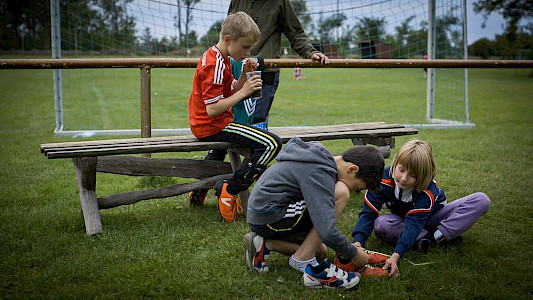
Once the East German village Golzow was famous for Winfried Junge's longterm-filmproject "die Kinder von Golzow". But the fame faded with time: Today there are 857 inhabitants, a small bakery, a takeaway, a primary school with too little children and a movie museum with too little visitors. Only the many memories remind people of better times."Refugees are an opportunity", mayor Frank Schütz states – and that is why two syrian families have now found their shelter in Golzow. Therefore the school has got enough students and a wind of change blows through the village. Schütz dreams of a growing fire department, a sports- as well as a danceclub.Family Sayed Ahmad for their part is attempting their new beginning. Halima and Fahdi try to adapt – being friendly throughout and studying German with perseverance. Their children do take part in the voluntary fire department and the family even settles with their own garden plot. But every time Halima thinks of her homeland she gets sad... and not everyone in Golzow is fine with the german refugee policy."The new Children of Golzow" tells the story of the village and its experiment while drawing a sensitive portrait of the family Sayed Ahmad.
The New Children of Golzow
Germany 2017, 58 minby Ilja Stahl
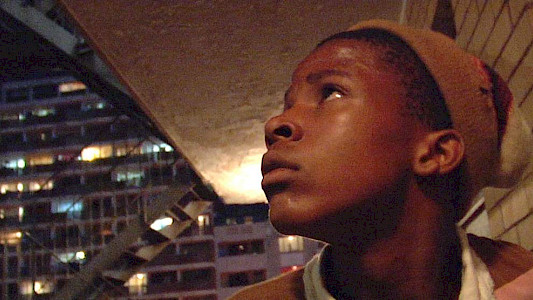
16-year-old Tebogo and 15-year-old Karabo live in Johannesburg's central district Hillbrow. In underground car parks, on high rise roofs and in nocturnal streets they dawdle away the time, somewhere between boredom and energy to burn.Writer and director Ilja Stahl's graduation film at the Academy of Media Arts Cologne was supported by the Film- und Medienstiftung NRW and shot entirely in Johannesburg/South Africa."Touching Concrete" celebrates its world premiere at the DOK Leipzig Filmfestival 2017 in the 'German competition'.Nominated for ver.di Prize for Solidarity, Humanity and Fairness, DEFA Sponsoring Prize DOK Leipzig catalogue, Ralph Eue:An enriching encounter! Whether coincidental or stage-managed isn’t relevant for the further interactions between filmmaker and filmed subjects. Because that “feeling of being there” described by Richard Leacock as the essence of the documentary soon eclipses all doubts and reservations. Impressed by the sure sense of style with which Ilja Stahl establishes the “right” kind of intimacy with his youthful protagonists in an overpopulated neighbourhood of Johannesburg, one feels happy to be allowed to drift with 16-year-old Tebogo and 15-year-old Karabo through their turf as a spectator for one summer. Their turf, that’s underground car parks, high rise roofs, nocturnal streets, where they dawdle away the time, somewhere between boredom and energy to burn.The conflicts with their single mothers, however, the violence and death in the streets are omnipresent. Karabo feels the pressure more and more while Tebogo sees it as a continuous supply of material for games. He lives by the “anyway” principle when he balances on the parapet of a high rise roof or dances into the path of moving cars with friends and defies everything with a provoking smile. It’s touching how the future looms over these kids’ presence. But they refuse to allow it to rule them. At least not yet.
Touching Concrete
Germany 2016, 87 minby Philip Gnadt, Mickey Yamine
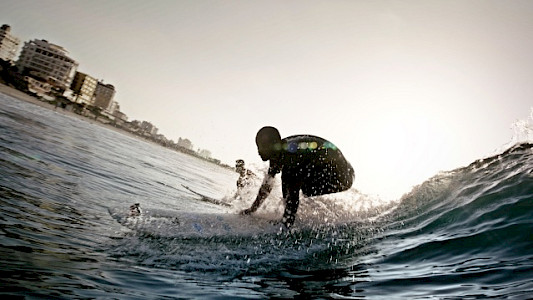
Gaza – a strip of land with a population of 1.7 million citizens, wedged between Israel and Egypt and isolated from the outside world. 26 miles of coastline with a harbor that no longer services ships. Hardly anything gets into Gaza and even less gets out. The young generation is growing up with very little perspective - occupied and jobless. But against this background there is a small movement.Our protagonists are part of the surf community of Gaza City. Round about 40 surfboards have been brought into the country over the past decades with great effort and despite strict sanctions. It is those boards that give them an opportunity to experience a small slice of freedom - between the coastal reminder of a depressing reality and the Israeli-controlled three mile marine border.
GAZA SURF CLUB
2008, 86 min
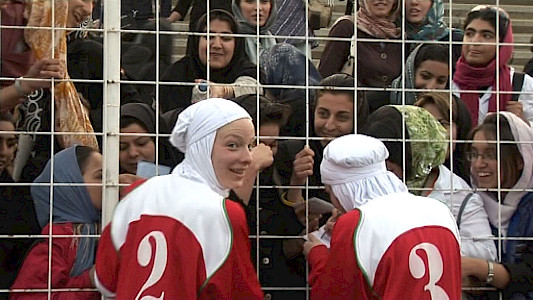
Narmila is on the Iranian Women's national football team, they’re dedicated, they train, they love football, but they have one problem, they are not allowed to compete.Under Iranian law only men can participate in or watch a sporting match.When Marlene, the left back on the Berlin-Kreuzberg women’s team, hears of this, she decides to do something about it. She spends the next year in a difficult struggle with the Iranian government to get a match arranged between her team and the Iranian women’s team. Finally, she and her colleagues manage to get through the red tape, the approval is granted and the game takes place. Men are banned from attending, and the morals police stand outside to prevent anyone from peaking inside. Inside, even though it was forbidden to advertise the match, 1000 women chant and cheer. The excitement ignites the stadium until over the loudspeaker a woman’s voice reminds them to behave decently and tend their hijab.Football Under Cover is more than a film about a football match. It’s a film about real life in a restrictive culture where women are severely controlled by men, but still through it all, self expression worms its way out. 52 & 86 minutes, HD
Football Under Cover
Bitte aktivieren Sie Javascript, um auf unsere Website zugreifen zu können.