2022, 92 minby Markus CM Schmidt
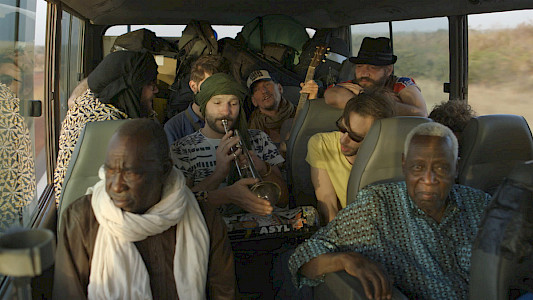
Popular music has its roots in West Africa, and especially in Mali. In Berlin, a bigband discovers old vinyls from the Malian Bigband era, music which embodied the hope for Malian independence before a coup brought an end to the legendary brass sections. Inspired by these songs, the Berliners travel to Mali to find the heroes of their vinyl-collection. There they research the origins of the songs, marvel at old archive footage and bring back the lost brass sections to play with forgotten Malian
Le Mali 70
Germany 2017, 90 minby Martin Farkas
“After all, these are not good memories, fun memories. And really, that time is buried.” Between 30 April and 4 May 1945, several hundred civilians commited mass suicide in the Pomeranian town of Demmin. There was desperation between the ideological void and the fear of the Red Army. Whole families drowned, hanged or poisoned themselves. The nervousness of the old citizens of Demmin whom Martin Farkas visits is still noticeable: not a hand that stays motionless during the interview – they are ru
Living in Demmin
Germany 2013, 52 minby Katrin Rothe
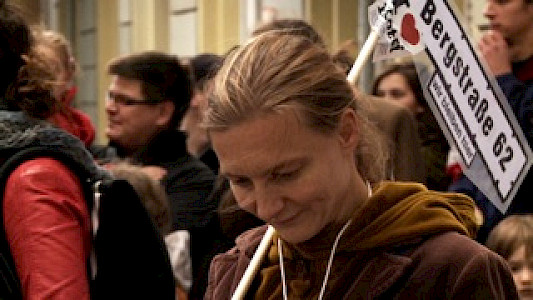
Rents have been exploding in Berlin, but it's not as bad as London or Paris yet. Students, families and pensioners can still live in the centre of Berlin. But affordable homes are getting scarce. International investors have also discovered the flat-trade in Berlin. The loosers of that boom are the tenants. The filmmakers house was bought by investors of a 'dynamic' estate company, who want to convert the rental flats into freehold flats. But sales don't override contracts, and tenants in Berl
CONCRETE GOLD
Germany 2011, 97 minby Annekatrin Hendel
Once with the Stasi, always with the Stasi? Once you were in the agent controller's grasp you could never escape - that's what they say, anyway. Writer Paul Gratzik was an unofficial informer for the GDR State Security Service for twenty years, broke with them in the 80's and exposed his identity. "Vaterlandsverräter" ("Traitors to the Fatherland") is a portrait of an exceptional man. On one hand it is a psychological profile of one of an extraordinarily paradoxical figure, a "man of extrem
VATERLANDSVERRAETER
Germany 2010, 90 minby Dagmar Brendecke
Cato Bontjes van Beek's childhood was paradise. She, her sister Mietje and their brother Tim were very close In the 1930s Cato moves to Berlin. Here she learns the truth about the war and the cruelties in the occupied countries. She is stunned and gets involved in the "Rote Kapelle", a resistance organisation. Together with her sister Mietje, she organizes help for prisoners of war. With her friend Heinz Strelow she types leaflets against the war. Cato did what she could. Highly risky perhaps ho
CATO
Germany 2009, 60 minby Christian Schidlowski (Christoph Tubbenthal)
The documentary tells the story of four Chinese social climbers in Hamburg, which are trained for a global mission. There is no other European city that is as highly regarded by these well-trained Chinese. But while other waves of emigration around the turn of the century formed whole districts, the Chinese influence on the European society apparently passed by unnoticeably. The film explores the main question of the daily challenges of our protagonists. What does it mean for them to live and wo
HANBAO - THE CASTLE OF THE CHINESE
You can contribute updates for the current person (martin langner).
Bitte aktivieren Sie Javascript, um auf unsere Website zugreifen zu können.