Germany 2021, 88 minby Christian Bäucker
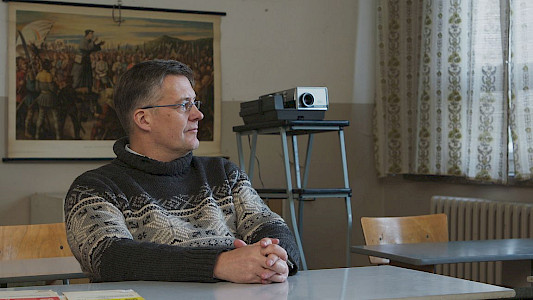
In his film HEIMATKUNDE, the director returns to the school building of his childhood in East Germany. For almost 25 years it lay empty, seemingly waiting to be revived. The remains of socialist education are pasted over, hidden, forgotten.In tentative interviews with contemporary witnesses we are gradually coming nearer to the systematic manipulation of the child’s mind. In this way, it becomes understandable how the dictatorship functioned and turned into the commonplace “that’s just the way i
The Lasting Formation
Germany 2020, 68 minby Ekaterina Reinbold
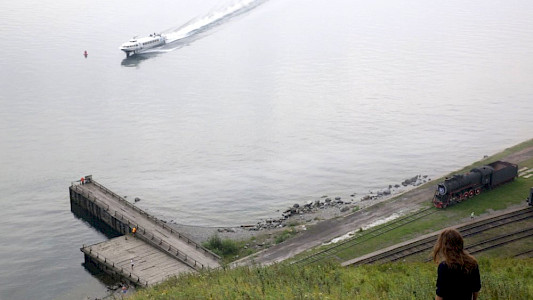
The movie где остался домовой / STANDING IN FRONT OF MANY HOUSES has two titles. The literal translation from Russian is .Where did the Domovoi go?. and refers to an old Slavic popular belief. Hence the house spirit, the Domovoi, ensures the protection and peace of a place. The English title plays with the impossibility of a direct translation of this figure and describes through the vivid STANDING IN FRONT OF MANY HOUSES the feeling of being lost in a diasporic experience. где остался домовой /
Standing in Front of Many Houses
Germany, Austria, Bosnia-Herzegovina 2020, 70 minby Clarissa Thieme
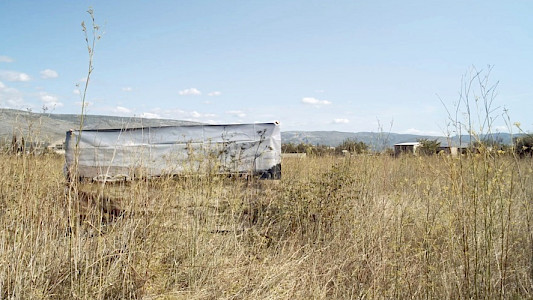
„Was bleibt I Šta ostaje I What remains / Re-visited" is a re-encounter with the places and landscapes that already played the leading role in Thieme's „Was bleibt I Šta ostaje I What remains" (Berlinale 2010): Sites of War Crimes in the 1990s in Bosnia Herzegovina. Ten years later, Thieme returns to them – with those past recordings in tow. „Was bleibt I Šta ostaje I What remains / Re-visited" is an experimental filmic setup that invites interactions from locals without forcing them. The result
What Remains / Re-visited
Germany 2019, 119 minby Ute Adamczewski
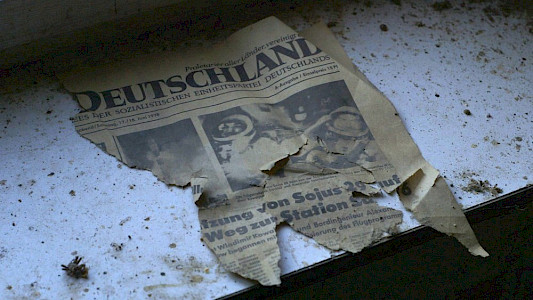
STATUS AND TERRAIN tells the story of an escalation. Its point of departure are the so-called early concentration camps. Set up immediately after the National Socialist seizure of power they aimed at the elimination of political opponents. Today these camps are largely forgotten. STATUS AND TERRAIN is about the way time has overwritten these sites, and about how different political cultures of remembrance have become inscribed in them. The Film entangles three periods of German History. They for
Status and Terrain
2018, 36 minby Heinz Emigholz
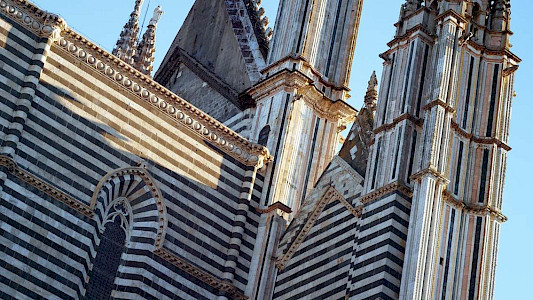
A confrontation and comparison of two church buildings, which could hardly be more different, but also a dialogue between various concepts of church and community: the Protestant Grundtvig’s Church in Copenhagen and the Catholic Cathedral in Orvieto. The cathedral in the central square in the middle of the city of Orvieto, with its visual histories in the interior and on the façade, and the imposing brick building of the church on the edges of Copenhagen, which forms the center of a housing comp
Two Basilicas
You can contribute updates for the current person ( Jochen Jezussek).
Bitte aktivieren Sie Javascript, um auf unsere Website zugreifen zu können.