Germany 2013, 74 minby Helga Reidemeister
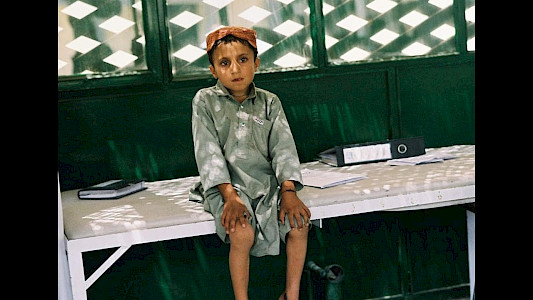
S H A T T E R E D AFGHANISTAN recounts, in fragments, stories of tender affinity and existential need. In Kabul’s National Museum, Afghan archeologists attempt to reassemble works of art that were shattered by the Taliban. Their attempts seem surreal. Street scenes of the destroyed city leave us confused, stuck between curiosity and horror. The misery of more than thirty years of war comes painfully alive. But there is a place of hope and assistance where our horror is displaced by a feeling of surprise. Shattered bodies, physical destitution, men, women, and children who have lost limbs are being treated. Here in the orthopedic center, the heart of the Red Cross in Kabul, there is a friendly atmosphere, cheerful, even hopeful and lively. Alberto, the head of the clinic, thinks it is a miracle when a young boy, Sher Ahmad, walks back into life. We accompany Sher Ahmad as he journeys back to his small village in southern Afghanistan, on the border with Pakistan.
SHATTERED AFGHANISTAN - How Can I Imagine Peace?
Germany 2009, 87 minby Helga Reidemeister
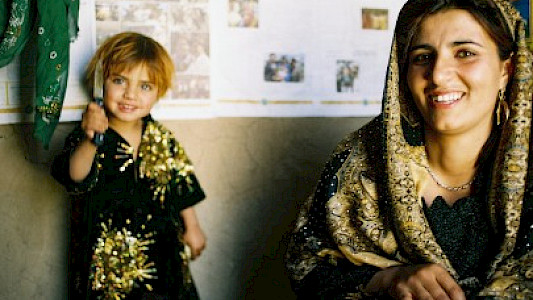
Hossein and Shaima have loved each other since childhood. As teenagers they were separated by war. They meet again in Kabul in the 1990s. Poverty forces Hossein to fight in the war. A shell splinter leaves him a paraplegic. Shortly afterwards, Shaima is sold in marriage to a man 40 years her senior. Shaima, who is the man’s fourth wife, falls pregnant. But Shaima’s husband still owes half the dowry, and so her father brings her back into the constraining patriarchal fold of the family, where she lives today with her fiveyear- old daughter. This situation doesn’t prevent the two lovers from seeing each other as much as possible – even though this means going against their families’ hard and fast rules. They both dream of living together in peace. Caught on the horns of a dilemma, and in constant fear of revenge on the part of the male members of both families who adhere to the harsh tribal laws handed down from the Middle Ages, Hossein and Shaima struggle under the most difficult circumstances imaginable to hold on to their love. This film describes the infringement of a taboo, the outcome of which is still uncertain. In an environment where war and want have dealt heavy blows on compassion and humanity and the family is the only remaining social bond, the chances of personal happiness are very slim indeed.
WAR AND LOVE IN KABUL
Germany 2004, 93 minby Helga Reidemeister
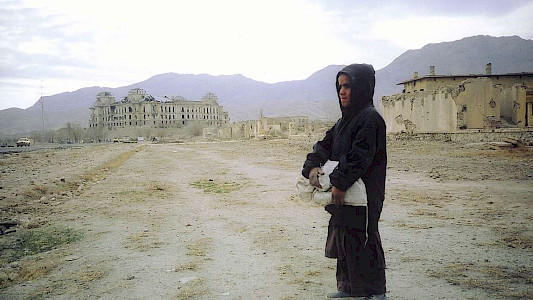
Helga Reidemeister portrays four women from Afghanistan—Jamila Mujahed, India—Arundhati Roy, Serbia—Stasa Zajovic and the USA—Sissy Farenthold, who demonstrate their opposition to nationalism and war.In TEXAS—KABUL director Helga Reidemeister shows four committed women, who do not tolerate war and don’t want to be silent about it.A political road movie, a journey around the planet, searching for meaning in times of war, and a journey into the own past. The director, worried by the announcement of the wars following the tragedy of September 11th in New York, seeks allies to act prudently in the panic erupted.She finds four women in four different countries of the world. Arundhati Roy, from New Delhi, world famous writer of the novel “The God of Small Things” is considered to be “the voice of the third world” and a militant opponent of globalization.Stasa Zajovic, from Belgrade, a founder of the pacifist group “Women in Black”, was active in resistance against the Milosevic dictatorship. She was awarded with the „Millennium Peace Prize“ of the UN in 2000.Jamila Mujahed has experienced 23 years of war in Kabul. She is the editor of “Malalai”, the only women’s magazine in Afghanistan. In 2004 she was awarded with the Johann-Philipp Palm Preis for the freedom of expression and freedom of press.Sissy Farenthold, law professor from Texas, former Member of Parliament and candidate for the post of Gouverneur, worked as a human rights observer for the UN. She is now preparing a tribunal for Iraq war.
TEXAS - KABUL
Germany 1990, 83 minby Johann Feindt, Jeanine Meerapfel, Helga Reidemeister, Dieter Schumann, Tamara Trampe
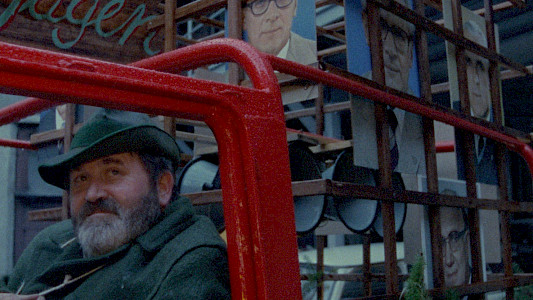
Rhine wine in Saxony! It is being served at an information stand set up by West Germany’s Christian Democratic Union party (CDU) just before the first and only free elections to East Germany’s People’s Assembly; the ballot will give the CDU almost 41% of the vote. But while the East Germans appear entirely sober about it all despite the sweet swill on offer, during the election campaign in February/March of 1990 the West Germans seem drunk on the new order. “Socialism is over. Nobody wants it anymore”, exults Helmut Kohl. Meanwhile, his finance minister is speaking of an “expanded economic territory”. And very soon, a Nazi banner is proclaiming the “east regions” of Germany as the next goal for a “reunification”.“How do various generations experience the uncertainty, the disorientation and the reconsideration of East Germany’s old values?”, asked the East-West German documentary film collective Blick ins Land. In their questioning of workers, schoolchildren, border guards and police, a teacher and an East German state security (Stasi) officer about their experiences and feelings, the collective provided an unvarnished look at the downsides of the “splendid happiness”. Source of Synopsis
In the Splendour of Happiness
Bitte aktivieren Sie Javascript, um auf unsere Website zugreifen zu können.