2022, 80 minby Heinz Emigholz
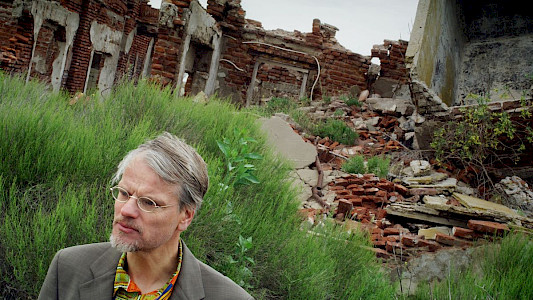
The quasi-fascist architecture of Francisco Salamone's slaughterhouses in the Argentine pampas, the utopian buildings by Freddy Mamani Sylvestre in El Alto, Bolivia, and the restorative "City Palace" in Berlin are the cornerstones of an analytical documentary film that explores the dual character of architectural modernism in the field of tension between avant-garde and political propaganda.The actor Stefan Kolosko acts as a diver in the sunken city of Epecuén, where he paraphrases a text by Jor
Slaughterhouses of Modernity
Germany 2022, 62 minby Heinz Emigholz
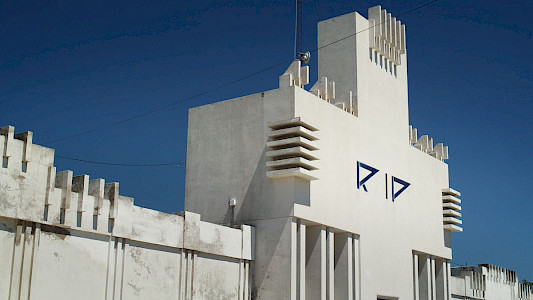
Slaughterhouses with concrete blades on top, monumental cemetery gates in the plains: Architect Francisco Salamone (1897–1959) shaped the image of the Argentinean pampa around Buenos Aires. In part 34 of his “Photography and beyond” series, Heinz Emigholz once more probes architecture for biographical traces. Salamone, who immigrated from Sicily as a child, realised his ideas between 1936 and 1940, when Mussolini’s Italy re-discovered architecture as an ideological craft.Axes seem to be buried i
Salamone, Pampa
Germany 2022, 95 minby Heinz Emigholz
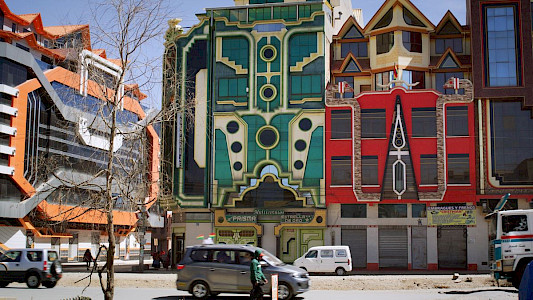
The Neo-Andean architecture of Freddy Mamani Sylvestre, influenced by indigenous culture, adorns the Bolivian city of El Alto. A psychoactive inspection at 4,000 metres above sea level.As a pioneer of Neo-Andean architecture, Freddy Mamani Silvestre attracts attention far beyond the borders of Bolivia. His non-conformist designs are influenced by the culture of the Aymara, the biggest ethnical group in the country, echoing their myths and patterns. Buildings constructed between 2008 and 2021 are
Mamani in El Alto
Germany 2020, 101 minby Heinz Emigholz
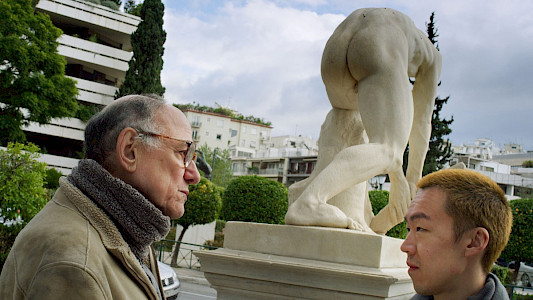
An archaeologist and a weapons designer, who knew each other in a previous life as a filmmaker and a psychoanalyst, meet at an excavation site in the Negev desert and begin a conversation about love and war, which they continue in the Israeli city of Be’er Sheva. A series of encounters with alternating actors in different roles ensues, which leads the viewer through the cities of Athens, Berlin, Hong Kong and São Paulo. Among those appearing are: an old artist who meets his younger self; a mothe
The Last City
Germany 2019, 93 minby Heinz Emigholz
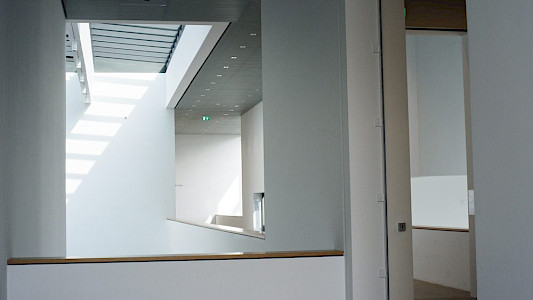
Demolition of the old and building of the new Kunsthalle in Mannheim in the years 2013 to 2018.
Years of Construction
2018, 36 minby Heinz Emigholz
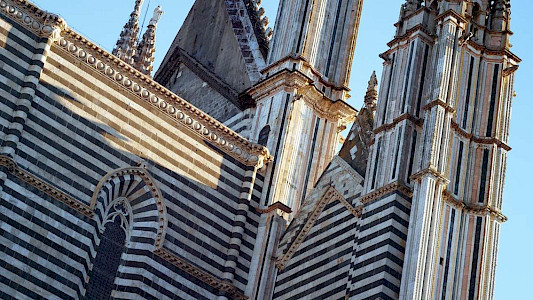
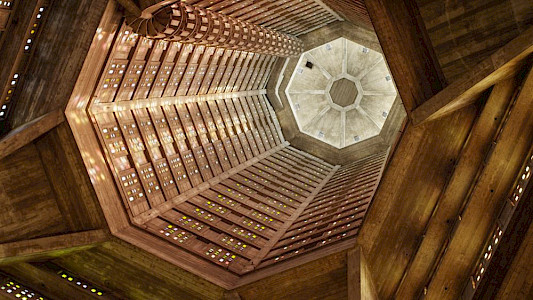
A confrontation and comparison of two church buildings, which could hardly be more different, but also a dialogue between various concepts of church and community: the Protestant Grundtvig’s Church in Copenhagen and the Catholic Cathedral in Orvieto. The cathedral in the central square in the middle of the city of Orvieto, with its visual histories in the interior and on the façade, and the imposing brick building of the church on the edges of Copenhagen, which forms the center of a housing comp
Two Basilicas
Germany 2014, 110 minby Heinz Emigholz
The film PERRET IN FRANCE AND ALGERIA presents thirty buildings and architectural ensembles of the French architects and construction engineers Auguste and Gustave Perret. Auguste Perret has masterfully refined concrete construction in the implementation of his projects and instilled in them a classical expression. Working in parallel to the execution of numerous construction projects in France, Perret was building under conditions of colonialism in North Africa. The film traces this division ch
PERRET IN FRANCE AND ALGERIA
Germany 2014, 108 minby Heinz Emigholz
Imagine an airspace into which a bomb has been dropped. The bomb has not reached the site of its detonation, but there is no way to stop its speedy approach. The time between the bomb’s release and its explosion is neither the future (for the ineluctable destruction has not yet happened) nor the past (which is unavoidably about to be extinguished). The flight time of the bomb thus describes absolute nothingness, the zero hour, consisting of all the possibilities that in just a moment will no lon
THE AIRSTRIP
Germany 2012, 100 minby Heinz Emigholz
Directors statement: "PARABETON starts with the first still exstant dome built of concrete by the Romans in the 1st century BC in Baiae near Naples. Followed in chronological sequence by twenty buildings of Italian civil-engineer Pier Luigi Nervi (1891-1979) – inventor, grandmaster of concrete structures and the architect's architect of the 20th century: among others the Pirelli-skysraper in Milano, the Headquarters of Unesco in Paris, the Palazzo del Lavoro in Turin, the Palazzo dello Sport in
PARABETON - PIER LUIGI NERVI AND ROMAN CONCRETE
Germany 2011, 91 minby Heinz Emigholz
A Series of Thoughts consists of four parts: El Greco in Toledo, Leonardo’s Tears, On Board the USS Ticonderoga and A Museum in Essen. The series comprises a train of thought on the religiously and politically motivated and, in military terms, strategically executed sacrifice of sons. El Greco in Toledo documents, in 2009, the existence of the painting “The Burial of the Count of Orgaz” that El Greco completed in 1588. Leonardo’s Tears combines all views of the Brazilian midfielder Leonardo Nas
A SERIES OF THOUGHTS
Germany 2008, 168 minby Heinz Emigholz
SENSE OF ARCHITECTURE
by Heinz Emigholz
Le Corbusier [IIIII] Asger Jorn [Relief] contrasts the Villa Savoye, built by Le Corbusier in 1931, and Asger Jorn’s Grand Relief, which the Danish painter and sculptor produced in 1959 for the Århus Statsgymnasium. The film makes connections between what does not belong together, at least not according to the ideological stipulations of their creators.“The film came about because I was intrigued by the premise of comparing two buildings that at first seem to have nothing to do with one another.
Le Corbusier [IIIII] Asger Jorn [Relief]
You can contribute updates for the current person (Heinz Emigholz).
Please enable JavaScript to access our website.
![Le Corbusier [IIIII] Asger Jorn [Relief]](/site/assets/files/401784/pic_1510710871_fb58d21441bc1771c7eff96c93b8f55e.533x300.jpeg)