Germany, France 2024, 98 minby Victor Kossakovsky
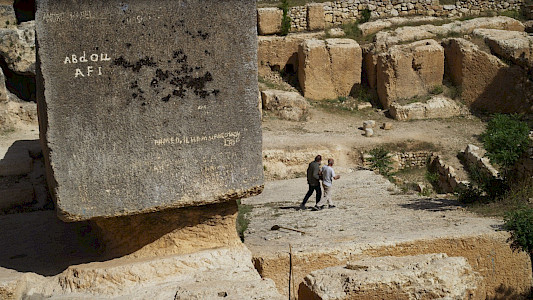
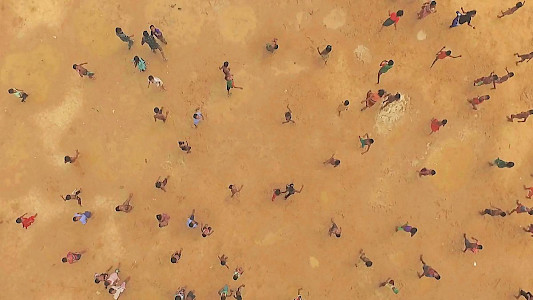
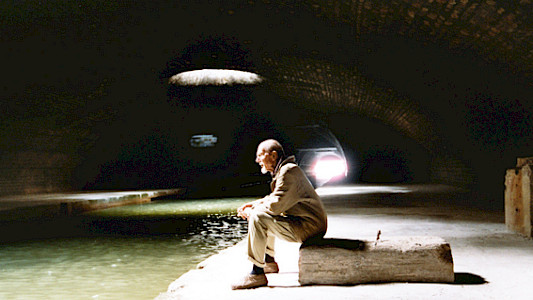
From filmmaker Victor Kossakovsky (Gunda, Aquarela) comes an epic, intimate and poetic meditation on architecture and how the design and construction of buildings from the ancient past reveal our destruction — and offer hope for survival and a way forward.Centering on a landscape project by the Italian architect Michele de Lucci, Kossakovsky uses the circle to reflect on the rise and fall of civilizations, capturing breathtaking imagery from the temple ruins of Baalbek in Lebanon, dating back to
Architecton
France, Senegal, Germany 2022, 105 minby Alassane Diago
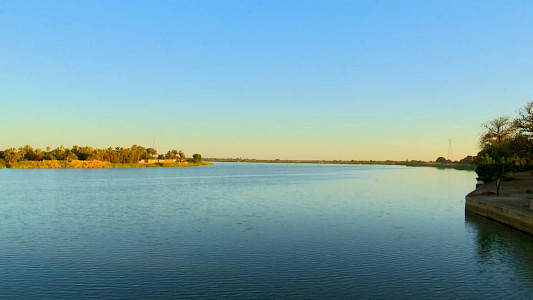
Forty protagonists, witnesses and victims look back at the 1989 massacres on both sides of the Senegal River, the border between Mauritania and Senegal, in order to understand what really happened, and try to take a step towards reconciliation together. [Semaine de la critique – 75 Locarno FF]"In 1989, after a clash near the border between Mauritanian shepherds and Senegalese peasants, an incredible escalation of racist violence took place in the two countries. These events caused thousands of d
The River is not a Border
Germany 2021, 111 minby Chris Wright, Stefan Kolbe
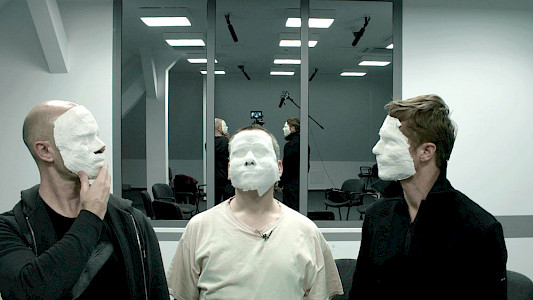
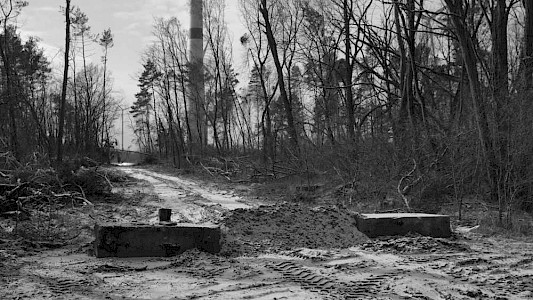
The filmmakers first meet Stefan in 2015, in the therapy ward of Brandenburg Prison. Their first impression is of a polite, shy man. A warder tells them Stefan is an ice-cold woman-killer.The filmmakers follow him through the last years of his prison term. They face some uncomfortable questions. Can anyone really know what is going on inside this man? The part of the protagonist is taken by a puppet, the scenes shift into theatre. Truth and falsehood blend in a cascade of presumption.
ANAMNESIS
Switzerland, Germany 2021, 110 minby Heidi Specogna
Nardos, an Azmari singer from Addis Ababa, dreams of telling stories about the lives of ordinary people through her music. In her search of stories for her songs, she meets Gennet, a poet who lives on the streets with her children. As Nardos puts the lives of Ethiopian women, their visions and power at the centre of her creation, we dive deeper and deeper into a rapidly changing country.
Stand Up My Beauty
Germany 2019, 84 minby Aysun Bademsoy
The National Socialist Underground murders in the early 2000s left scars. Not only among the relatives of the victims, but also in the migrant communities and the entire German society.TRACES follows these scars and poses the question of whether such injuries can ever heal completely.“Between September 2000 and April 2007, nine immigrant businessmen and a German policewoman were murdered. (…) I read the news about the murders and thought: That could have been my father or my brother.” We’re talk
Traces
Germany, Austria 2019, 218 minby Thomas Heise
The film picks up the biographical pieces of a family torn apart through the end of the 19th and into the 20th century.The used material is what remained of Thomas Heise’s family.It is about people who by chance found each other, only then to lose each other.Now it is their descendants, their children and grandchildren who are beginning to disappear.Fathers and mothers, sons and brothers, the affairs, the hurt and the joy in landscapes of transition – each bearing the intertwining, hallmarks of
Heimat is a Space in Time
Germany, Switzerland, Finland 2018, 90 minby Anja Kofmel
Croatia, January 1992. In the midst of the Yugoslav Wars, Chris, a young Swiss journalist is found dead in mysterious circumstances. He was wearing the uniform of an international mercenary group. Anja Kofmel was his cousin. As a little girl, she used to admire this handsome young man; now a grown-up woman, she decides to investigate his story, trying to understand what really was the involvement of Chris in the conflict…With: Megan Gay, Joel Basman, Michael Würtenberg, Veronika Schwab, Carlos I
Chris the Swiss
Germany, Denmark, Great Britain 2018, 90 minby Victor Kossakovsky
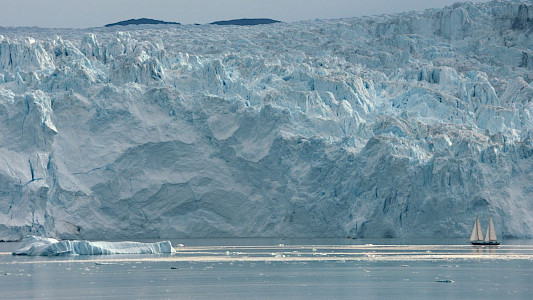
AQUARELA takes audiences on a deeply cinematic journey through the transformative beauty and raw power of water. Filmed at a rare 96 frames-per-second for 96 frames-per-second projection, the film is a visceral wake-up call that humans are no match for the sheer force and capricious will of Earth’s most precious element. From the precarious frozen waters of Russia’s Lake Baikal to Miami in the throes of Hurricane Irma to Venezuela’s mighty Angels Falls, water is AQUARELA’S main character, with d
Aquarela
Germany 2018, 72 minby Andreas Goldstein
My father Klaus Gysi - Jew and communist - made his career in the former GDR after years of illegality in Nazi Germany. The fall of socialism burnt his life efforts in one brief moment. The film THE COMMUNIST tries to reflect on his failure from the viewpoint of my own experiences within this historical time. My fundamental historical experience is opportunism. 1990 people already forgot what they believed in the year before. So did my father, one of the leading operatives of the GDR, who now ca
The Communist
2017, 140 minby Ai Weiwei
For the last two years, Ai Wei Wei has lived outside China as an involuntary emigré. The people that he met on a year-long journey through 23 countries aren't prominent dissidents or artists. They have fled war and misery, through jungle, over mountains and across seas. Ai Weiwei has been to Kenya and Iraq, Gaza and Italy, to refugee centres in Berlin and Greek beaches and talked to people who left everything behind. In haunting pictures, he gives space to the hopes, privations and fears of his
HUMAN FLOW
Germany 2014, 69 minby Hazem Alhamwi
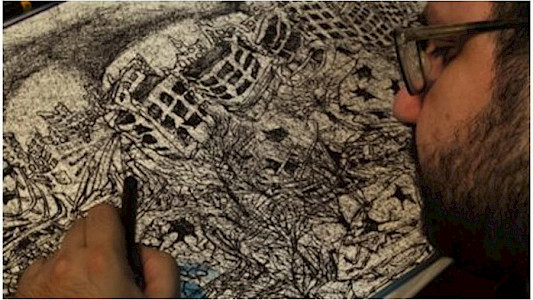
How can you keep your humanity in a dictatorship where you’re educated to erase in yourself any singularity? In his early years, the Syrian painter and filmmaker Hazem Alhamwi found his own way to live and to feel free, drawing obsessively in his own room. But in 2011, finally, the Revolution started. The Syrian people went out in the streets, facing Al-Assad’s army. Hazem Alhamwi found himself unable to face his terror immediately. How could he stay paralyzed in such an important moment in his
CARAVAN IN A ROOM
Germany, Romania 2010, 93 minby Dr. Titus Faschina
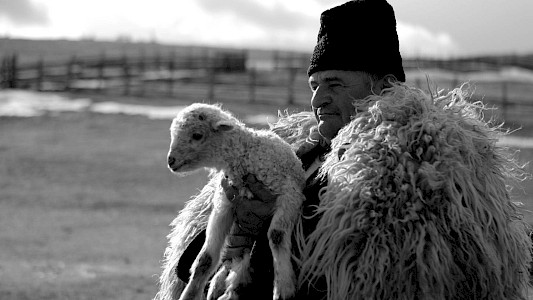
Dumitru Stanciu is one of the last mountain shepherds ofEurope. As his forefathers did for thousands of years, in summeras in winter he and his herd of sheep roam the far reachesof the Transylvanian Carpathian Mountains, close to the edge of heaven. Vivid histories and fantastic myths, far from the world of today, cinematically narrated over the course of a year. The last refugein Europe for a forgotten profession in an unhurried world.with: Dumitru Stanciu, Radu Stanciu, Maria Stanciu
CLOSE TO HEAVEN
Germany 2009, 166 minby Thomas Heise
Something always remains, a rest, that cannot be subsumed. (From EISENZEIT 1991) The Film MATERIAL contains observations, scenes, fragments, stories and processes. Images from the late eighties in the GDR to the immediate present of the year 2008 in Germany. The montage of these images creates a picture of these times, where past, present and future mirror one another. It is my picture. In 1987 author Heiner Müller brought me a video camera back from West Berlin and I began using it to record im
MATERIAL
Germany 2009by Boris Hars-Tschachotin
Charismatic, erratic, egocentric, almost forgotten… Sergej Tschachotin was a scientist of international repute, friend to Pavlov and Einstein, revolutionary and pacifist. His private life was changeful too: five marriages, eight sons. SERGEJ IN THE URN tells the story of Sergej Tschachotin’s epic existence - from 1883 to 1973 - through the memories of four of his sons. Speaking openly for the first time, they tell of Tschachotin’s role as a cancer researcher, his participation in anti-totalitari
SERGEJ IN THE URN
Germany 2008, 90 minby Qaushiq Mukherjee
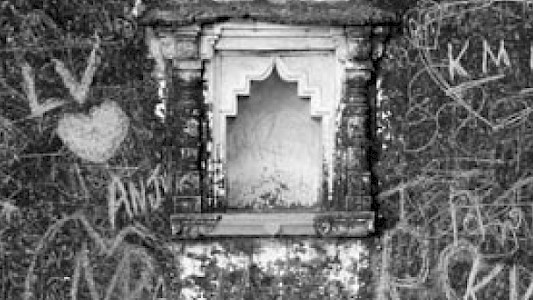
India is the birthplace of love. There’s nowhere else in the world where so much is dedicated to the idolizing and immortalizing of the concept of romance. India was one of the first civilizations to recognize the human need for love and give cultural expression to that, in poems, pictures and monuments. LOVE IN INDIA looks at how the concept of love has evolved and changed over the centuries. From the Kama Sutra to Shak Rukh Khan’s Bollywood movies, the viewer is treated to a voyage of disc
LOVE IN INDIA
You can contribute updates for the current person (Heino Deckert).
Please enable JavaScript to access our website.