Films by Frieder Schlaich

Producer
BERLIN EVICTION

Germany 2024, 92 min
by Johannes Blume

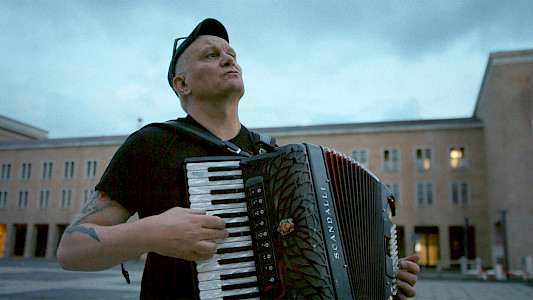
Berlin is teetering on the edge of complete gentrification. The punk movement is fading, and the remaining left autonomous and anti-fascist spaces are facing an existential threat. Gentrification jeopardizes their very existence, eradicating the once vast diversity in Berlin’s urban landscape.The capitalistic structures driving gentrification prioritize individual wealth and financial growth, undermining the importance of solidarity. The squatter scene — or the heritage of it — is the antidote. House communities live in and share what would normally be considered personal possessions: the kitchen, the bathroom, the living room — everything is communal. Activities and conflicts are resolved through consensus, and interaction with others is inevitable. Living in a house community is a full-time commitment, a synthesis of people, work, materials, and history.BERLIN EVICTION aims to rediscover the relevant values of the subculture for today’s society. We engage with people who have a rich history and are willing to speak candidly on camera, free from masks and control. We explore places and individuals that have repeatedly captured the attention of the national and international press due to their fight against the system and eviction, such as Rigaer Straße, Liebig 34, Syndikat, Drugstore, and many more. The imminent evictions of Potse and Köpi Wagenplatz, both iconic symbols of the autonomous and punk scene, serve as the pivotal narrative structure of the film, emphasizing the scene’s ongoing struggle throughout the years.MAX OPHÜLS PRIZE: BEST FILM MUSIC"Quotation from the film: "We had our time and now it's over." Music plays a very important role in this film, it is an expression of protest, anger, sadness and transports the content of the film. With a convincing interweaving of original music and film score, the film tells of the almost lost struggle for freedom beyond conventions and beyond capitalist constraints." say the members of the jury Jide Tom Akinleminu, Wolf-Maximilian Liebich, Andrina Mrancikar

Berlin Eviction

MAMANI IN EL ALTO

Germany 2022, 95 min
by Heinz Emigholz

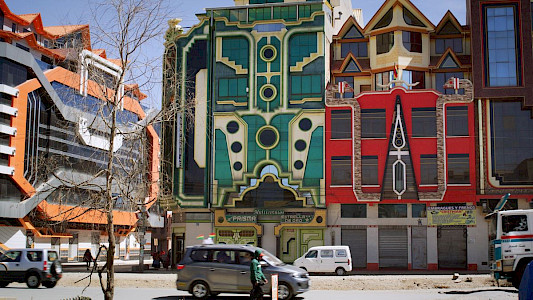
The Neo-Andean architecture of Freddy Mamani Sylvestre, influenced by indigenous culture, adorns the Bolivian city of El Alto. A psychoactive inspection at 4,000 metres above sea level.As a pioneer of Neo-Andean architecture, Freddy Mamani Silvestre attracts attention far beyond the borders of Bolivia. His non-conformist designs are influenced by the culture of the Aymara, the biggest ethnical group in the country, echoing their myths and patterns. Buildings constructed between 2008 and 2021 are circled, inspected and captured, in part 35 of the ongoing series “Photography and beyond”.Like giant jewels, the Cholets rise into the sky above the Bolivian city of El Alto, at 4,000 metres above sea level. Cholets, a neologism created from chalet and Cholo, the local term for indigenous people, are the creations of architect Freddy Mamani Silvestre, born in 1971. Several dozen buildings designed by him adorn the otherwise fairly unglamorous city otherwise mainly dominated by raw red brick. Mamani’s built fantasies, on the other hand, are striking, arrogant and bold. Snakes seem to be slithering up their facades, scattered diamonds cling to the glazing and occasionally the whole thing is crowned by a stand-alone residential building. But the Cholets are mainly used for festivities, because they house the so-called “salones de eventos”. Emigholz unlocks psychoactive places that evoke the interior of pinball machines and, in their confident splendour, triumph over the richer neighbouring city of La Paz. [65 DOK Leipzig, Carolin Weidner]

Mamani in El Alto

SCHLINGENSIEF — A VOICE THAT SHOOK THE SILENCE

Germany 2020, 124 min
by Bettina Böhler

Director Christoph Schlingensief's 'Heimat' films (Georg Seeßlen), performance art, installations and provocative theatrical, television, operatic and artistic productions shaped the cultural and political discourse in Germany for two decades before his death in 2010 at just 49 years of age.SCHLINGENSIEF – A Voice that Shook the Silence by Bettina Böhler is the first film that attempts to exhaustively document the vast spectrum of this exceptional artist's oeuvre.The film focuses on Christoph Schlingensief as a 'family person' (Schlingensief on Schlingensief) who dealt equally with his relationship to his parents and his relationship to Germany in his work. 'SCHLINGENSIEF – A Voice that Shook the Silence' traces his development from pubescent filmmaker with an artistic bloodlust to revolutionary stage director in Berlin and Bayreuth, and, ultimately, to Germany's 'national artist,' who was purportedly venerated by all and invited to create the German Pavilion for the 2011 Venice Biennale.'SCHLINGENSIEF – A Voice that Shook the Silence' explores Schlingensief's untiring, and ultimately inexhaustible, love-hate relationship to Germany, to its high culture, and to its petite-bourgeoisie sentiments – which he attributed to himself more than anyone else – via scenes of East Germans being made into sausage (Blackest Heart), shouts of 'Kill Helmut Kohl!' (documenta X) and an attempt to rehabilitate Wagner (Parsifal).With: Christoph Schlingensief, Margit Carstensen, Irm Hermann, Alfred Edel, Udo Kier, Sophie Rois, Bernhard Schütz, Helge Schneider, Dietrich Kuhlbrodt, Susanne Bredehöft, Tilda Swinton

SCHLINGENSIEF – A Voice that Shook the Silence

PARAPETON – PIER LUIGI NERVI AND ROMAN CONCRET

Germany 2012, 100 min
by Heinz Emigholz

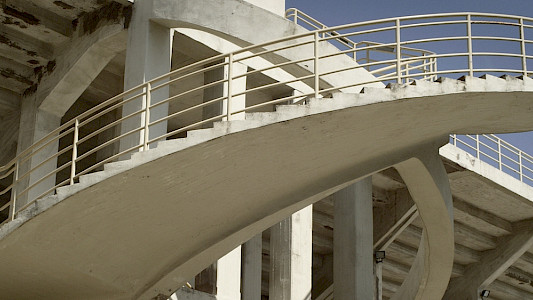
Directors statement: "PARABETON starts with the first still exstant dome built of concrete by the Romans in the 1st century BC in Baiae near Naples. Followed in chronological sequence by twenty buildings of Italian civil-engineer Pier Luigi Nervi (1891-1979) – inventor, grandmaster of concrete structures and the architect's architect of the 20th century: among others the Pirelli-skysraper in Milano, the Headquarters of Unesco in Paris, the Palazzo del Lavoro in Turin, the Palazzo dello Sport in Rome and the Papal Audience Hall at Vatican City. This succession is from time to time halted by cinematic studies of large Roman structures, among others the Pantheon and the Baths of Caracalla in Rome and Hadrian's Villa in Tivoli. In doing so the film relates Nervi's path-breaking constructions with the pioneering Roman inventions in his field 2000 years ago. The 100 minutes long film is the first of two parts of the project Decampment of Modernism with which I will conclude my series Architecture as Autobiography about the origins, fate, glory and decline of modern architecture. In a way, PARABETON will be the "grand finale" of the series by going back to the Roman origins of the constructional core of Modernism." We will see (in order of appearance): Tempio di Mercurio, Baiae 1st cen. B.C. Municipal Stadium, Florence 1932 Experimental warehouse, Rome 1945 Tempio di Giove Anxur, Terracina 1st cen. B.C. Exhibition Hall B, Turin 1948 Exhibition Hall C, Turin 1950 Salt Warehouses, Tortona 1951 Tobacco Factory, Bologna 1953 Terme di Caracalla, Rome 3rd cen A.D. UNESCO Headquarters, Paris 1958 Pantheon, Rome 2nd cen. A.D. Small Sports Complex, Rome 1957 Tempio di Minerva, Rome 3rd cen. A.D. Pirelli Tower, Milan 1958 Flaminio Stadium, Rome 1959 Colosseum e Forum Romanum, Rome 1st cen B.C. Sports Complex, Rome 1960 Aqua Claudia, Rome 1st cen A.D. Train Station, Savona 1960 Palace of Labour, Turin 1961 Villa Adriana, Rome 2nd cen. A.D. Burgo Paper Factory, Mantua 1962 Mausoleo Tor de ’Schiavi, Rome 4th cen. A.D. Roof of the Cuore Immacolato di Maria Church, Bologna 1962 Palatin and Motor boat in ferro-cement, Rome 1967 Papal Audience Hall, Vatican City, Rome 1971 [source: http://www.filmgalerie451.de/en/filme/parabeton/ ]

PARABETON - PIER LUIGI NERVI AND ROMAN CONCRETE

Testmann

Germany 2011, 97 min
by Elfi Mikesch

Werner Schroeter was one of the most significant proponents of New German Cinema. Schroeter was diagnosed with cancer in 2006. At the time, he was working for the Kunsthalle Düsseldorf gallery on a musical piece entitled ‘Schönheit der Schatten’ (The Beauty of Shadows) based on the works of Robert Schumann and Heinrich Heine. For Schroeter, oscillating between hope and trepidation, it marked the beginning of a race against time. In her film, Elfi Mikesch, who photographed a number of Schroeter’s films and who collaborated closely with him to create his vision, provides us with an intimate insight into Schroeter’s artistic output during the remaining four years of his life.MONDO LUX portrays Schroeter full of creative energy and enthusiasm for the cinema, theatre and photography. We observe him at rehearsals for ‘Antigone/Elektra’; preparing the photographic exhibition ‘Autrefois & Toujours’ and working intensively on the dubbed version of his last film,DIESE NACHT, which was shot in Portugal in 2008.Copious excerpts from Schroeter’s films, ranging from EIKA KATAPPA (1969) to DIESE NACHT (2009), reflect the colourful spectrum of his oeuvre, inscribed in a retrospective view that is pervaded by music. The film also illuminates biographical connections and enshrines the passionate bond that Schroeter felt towards film, opera and theatre, but also towards his friends, the people with whom he lived and worked. Schroeter was an artist propelled by Eros and by passion, a man who feltthe proximity of both beauty and death. MONDO LUX constitutes an intimate space - a space in which, in view of the time the protagonist has left to live, every day becomes quite unlike any other. Werner Schroeter died on 12 April, 2010.With Werner Schroeter, Anne Ratte-Polle, Almut Zilcher, Pascale Schiller, Doerte Lyssewski, Isabelle Huppert, Rosa von Praunheim, Wim Wenders, Peter Kern, Ingrid Caven.

Mondo Lux - The Visual Worlds of Werner Schroeter