Germany 2024, 85 minby Kristine Nrecaj, Birthe Templin
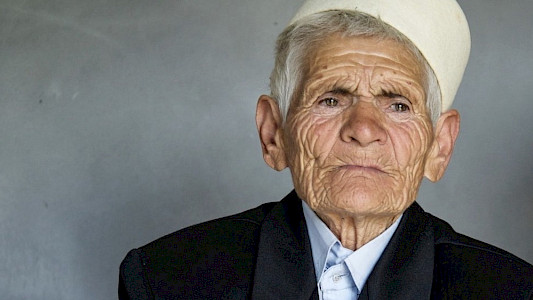
HOUSE WITH A VOICE tells the story of six Burrneshas who, for different reasons, have decided to take on the social role of men. They have done this to circumvent patriarchal structures, to avoid misogynistic attacks, to support the family economically, to avoid compelled marriage and to be free. Our characters communicate with us intimately as they talk about their lives and bring us closely into their personal journey. They speak about freedom and oppression, about the promise of sacrificing t
House with a Voice
Germany 2023, 24 minby Therese Koppe
Mariella lives in Berlin with her family of seven. Her father was trained in kung fu martial arts at the Chinese Shaolin monastery. Today he runs the Berlin-Schöneberg kung fu school and prepares her and her sisters for the next tournament. This has been part of Mariella’s life for many years. But the nervousness before each competition never really gets better. [66 DOK Leipzig, Lina Dinkla]
The Daughter of the Shaolin Master
Germany 2022, 96 minby Eric Esser
An inherited family treasure trove of photos and film footage show the director's grandfather in southern Germany in the 1940s. In one clip, the grandfather is briefly seen at a funfair wearing a swastika on hisjacket. How is our perception of a loved one changed through a symbol that stands for murder by the millions? How can photos and film footage, memories and archival material, be pieced together to form a coherentpicture? A struggle for memory – and a search whose persistence ultimately ru
Family Love
Germany 2020, 90 minby Sharon Ryba-Kahn
Sharon's relationship with Germany has always been conflictual to say the least, at the same this was something she had just accepted. This is true although, she was born in Munich and currently lives in Berlin. Sharon is Jewish and a third generation Shoah survivor. When her estranged father Moritz contacts her again after 7 years, it becomes an impetus for her to reconstruct her father's family history. From here on a journey begins in which Sharon, tries to understand who her father is and w
Displaced
2019, 73 minby Therese Koppe
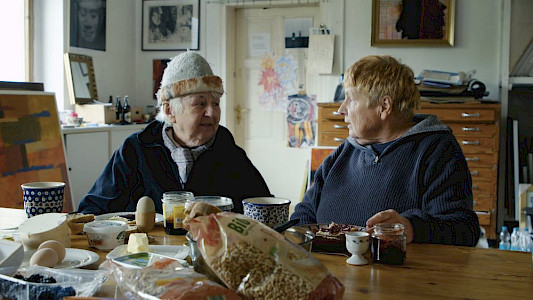
Erika and Tine are 81 and have been a couple for 40 years. The two women live on a farm in Brandenburg they restored themselves and look back on eventful lives. In the GDR they both had to fight for personal and artistic freedom and struggled daily with socialism, not to mention its actually existing contradictions. Unlike other GDR creative artists who cracked under the rejection of their art and ideas, they both take a humorous look back today at the manifold documents of their lives, contextu
A Quiet Resistance
2018, 91 minby Kirstin Schmitt
The eccentric couple Adelheid (78) and Kornelius (82) have been married for 53 years and only have themselves. They maintain a very individualistic lifestyle which often leads to a lot of astonishment by their fellow citizens. As of their stubbornness they only have themselves and fight to spend as much time together in the future as possible. The forceful Kornelius is the dominant part of their relationship. So far, Adelheid has always just gone along with everything, never having to make any d
Adelheid, Kornelius & The Deaths
You can contribute updates for the current person (Evelyn Rack).
Please enable JavaScript to access our website.