Germany 2023, 178 minby Volker Koepp
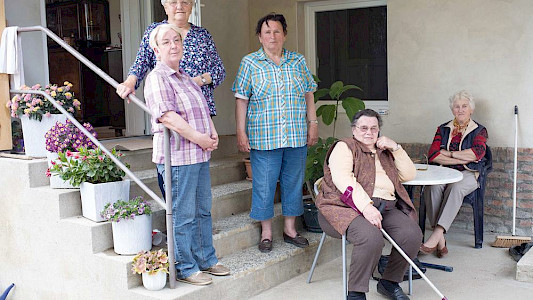
In Uwe Johnson’s last study in the English town of Sheerness, there was a map of Mecklenburg on the wall – the region of his childhood, to which he never returned after his emigration to the West and could only reconstruct in the literary sense afterwards. Volker Koepp’s film is conceived as a geobiography: he travels with Johnson’s texts to places from the author’s life, finding people and landscapes connected to his work and his person, sometimes closely, sometimes more loosely. Koepp’s and Johnson’s poetic projects intertwine: their landscapes and biographies resist linear progression; history remains stored in them only to reveal itself again and again. For Johnson, when he swims in the Baltic Sea, the dead are present, floating in the Bay of Lübeck after the 1945 sinking of the Cap Arcona. Koepp speaks with a woman who recalls how holidaying in Italy evoked thoughts of those fleeing across the Mediterranean by boat. Johnson’s sorrow at the invasion of Prague by Warsaw Pact troops is mirrored in Russia’s ongoing attack on Ukraine, which affects the filming. When a river flows slowly, it can change direction with even just a little wind and return to its source. ( catalogue text by Jan Künemund, 53 Berlinale Forum @ 73 BERLINALE)With Judith Zander, Peter Kurth, Heinz Lehmbäcker, Hanna Lehmbäcker, Hans-Jürgen Syberberg
Leaving and Staying
Germany 2018, 135 minby Volker Koepp
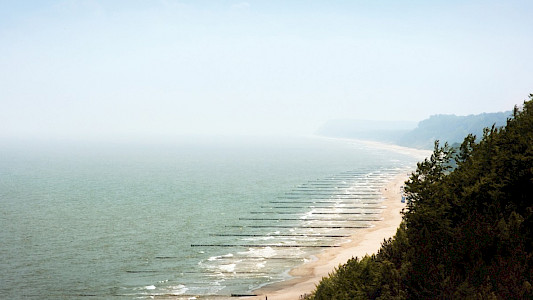
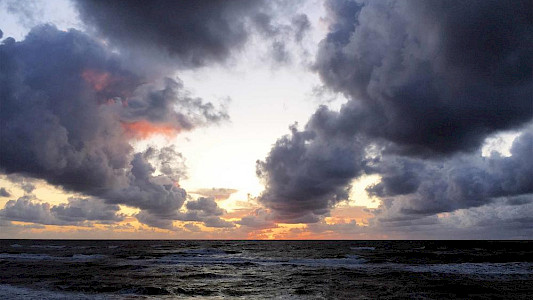
With SEESTÜCK, Volker Koepp concludes a series of documentaries that he began in 2010 with BERLIN-STETTIN. In this film, the director mixed autobiographical references with his description of East German film and living spaces for the first time. IN SARMATIA, 2013 he expanded the view of the region east of the Weichsel (Vistula) and between the Black Sea and the Baltic Sea. With LANDSTÜCK, 2016, Volker Koepp returned to the Uckermark in the north of Berlin. SEESTÜCK - a film about the Baltic Sea, about life by the sea and with the sea - concludes the series. As in the films before, the arcs of history are reflected here in the private lives of the present. The following also applies to the small Baltic Sea: landscape is world view.
SEESTÜCK
2016, 122 minby Volker Koepp
Idyllic landscape shots and conversations with local inhabitants convey the different facets of theUckermark in eastern Germany: a unique natural habitat, an embodiment of demographic change,a battle zone where agribusiness and organic farming duke it out. The end moraines of the Uckermark have kept Volker Koepp busy for decades. Following the socio-historical Uckermark, he devotes himself in Landstück even more intensively to conveying the sensory experience of this sparsely populated, ecologically fascinating region between Berlin and the Baltic Sea. The swamp waters rippling in the wind and the swaying treetops and grain fields are like an incitement to focus the gaze on the essence of this swathe of land. When locals and visitors alike rave about the alfalfa fields that prevent desertification but are threatened by conventional farming, when they identify wild herbs at risk of extinction in a small field, taste wild lamb’s lettuce, lentil vetch and field violets, the film becomes a hymn to those resisting the industrialisation of agriculture and the destruction of this cultural landscape. Whether the region’s 10 percent organic farmers, local beekeepers or the new inhabitants of a 50-year-old prefab who look out of their windows mesmerised – it’s a respect for nature that unites these otherwise so different neighbours whom Koepp portrays in his film.(Berlinale FORUM, Christoph Terhechte)
Piece Of Land
Bitte aktivieren Sie Javascript, um auf unsere Website zugreifen zu können.