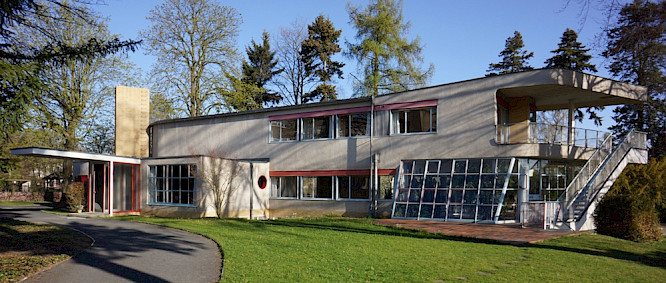
Synopsis
In the small town of Löbau in Saxony, tucked away behind a closed-down factory, lies one of the most striking houses of architectural modernism, the Schminke house. It was built from 1930 till 1933 by the architect Hans Scharoun for the noodle manufacturer Fritz Schminke and his familiy. Here, shortly before the Nazi years began, a world class architectural monument was created, a house full of light and open spaces, which the people from the town called the “noodle steamship”, owing to the many architectural references to ships. The film tells the story of a modern house, which seems to have fallen outside of its time. Klaus Küvers, an historian of architecture, leads the viewer through the house, while Helga Zumpfe, a daughter of the Schminkes, and Ello Hirschfeld, who as a Jewish girl and foster child survived the Nazis here, tell us how the noodle steamship, meant carefree childhood days for them. Achim Wendschuh, an architect close to Hans Scharoun, explains the principles of the undertaking. In this way the film combines architecture with what a house can mean for its inhabitants.