Films

We are updating this film database for 30 years - so have fun exploring!

You can create your very own catalogue, sorted by your personalized search criteria.
Therefore, you only have to choose your filters and download the emerging pdf.

Loading...
125 films found. Download PDF (approx. 130 pages)
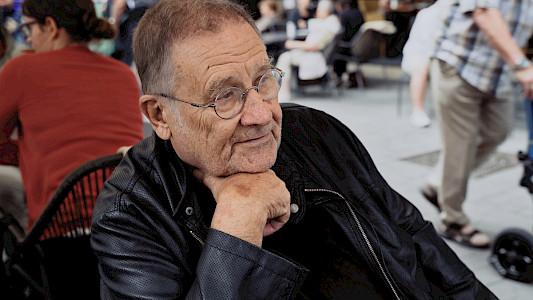
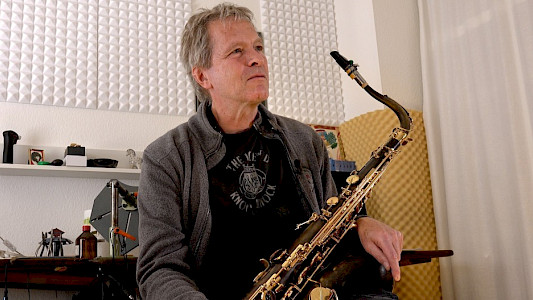
TALKING TO YOU. CHRISTOPH LAUER (SAX)

Germany 2023, 92 min
by Lucie Herrmann

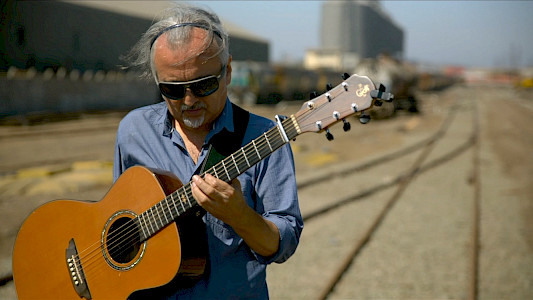
A film about the love of jazz, but also about the love of the saxophone, that magical instrument. "I tell something about myself by playing and putting together sounds. That's my story," says Christof Lauer. He is one of the great jazz saxophonists in Europe, was a member of Albert Mangelsdorff's quintet and the United Jazz + Rock Ensemble. He was a soloist in the NDR Big Band in Hamburg for 25 years and has also been a soloist in the jazz ensemble of the Hessischer Rundfunk since 1970.How can the magic emanating from the tenor or soprano saxophone be explained? Who actually makes these instruments? And how did Christof Lauer manage to rekindle his love of jazz over decades? TALKING TO YOU penetrates the musical cosmos of an idiosyncratic musician who rejects any routine and persistently works on new forms. The main thing is that: "it has to be intense"."At last, here is a music portrait that takes its subject seriously and doesn't fade out individual pieces after just a few seconds. Lucie Herrmann, who already created a memorial to the Frankfurt 'trombone world champion' Albert Mangelsdorff with the portrait 'Oh Horn!', and her great camera and editing partner Bert Schmidt have not only succeeded in creating a hymn to one of the most important advocates of contemporary improvisation art with 'Talking To You'. This film is much more than a portrait of a musician. It is a passionate declaration of love for jazz."(Peter Kemper, FAZ, April 21, 2023)

Talking to You

TASTENARBEITER – ALEXANDER VON SCHLIPPENBACH

Germany 2023, 106 min
by Tilman Urbach

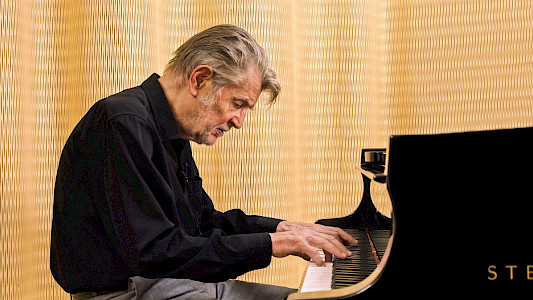
Alexander von Schlippenbach is a free jazz hero from Berlin who experienced total freedom in music from the 1960s on. The film follows him to the present day and also considers the political background of European free jazz in the spirit of optimism of the '68 movement. In the film v. Schlippenbach meets old companions. He travels to a studio in Cologne where he meets up with trumpeter Manfred Schoof. As they play together they reminisce about the 60s, when jazz was free of any entertainment attitude. Free Jazz was the expression of a radical social utopia. In Dresden, v. Schlippenbach meets the percussionist Günter 'Baby' Sommer and talks about the numerous concerts the two free jazzers played together in the GDR, where they used to be celebrated like pop stars. Here thousands of fans understood the FreeJazz as an expression of freedom. In Borken the label boss Jost Gebers shows his FMP archive and discovers photos and band recordings from Schlippenbach's early days. Also in the scene Gebers makes v. Schlippenbach more clear as a person. The camera observes Alexander v. Schlippenbach not only at home, where he lives in Moabit with his wife, jazz pianist Aki Takase, but also on tour in Munich. Nevertheless, the film TASTENARBEITER – ALEXANDER VON SCHLIPPENBACHis neither a pure music film nor a concert film, but rather concentrates on the biographical breaks and disappointments in life, but also on his spirit of optimism that happend to v. Schlippenbach.

Tastenarbeiter – Alexander von Schlippenbach

VIENNA CALLING

2023, 83 min
by Philipp Jedicke

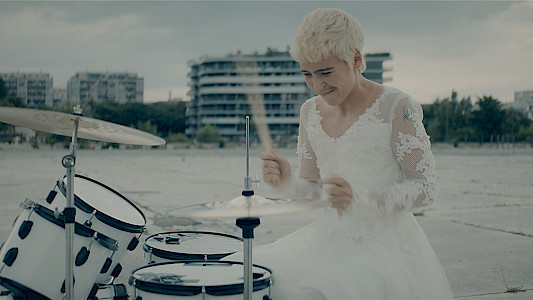
Vienna, the former music capital of Europe, has become increasingly relevant again. With the wry approach that is typical of this city, the young underground music scene there romanticizes the raw and rabid. Hedonist and nihilist at the same time, the young Viennese artists embody the opposite of self-optimization. They are unadjusted, eccentric characters – and they are filling concert halls not only in Austria, but also in Germany and Switzerland. VIENNA CALLING starts with the aim of being a music documentary. But increasingly, the true protagonist emerges as the city of Vienna itself. Like a flâneur, the camera saunters by day and night through the lanes, bars and casual joints of Vienna, taking diversions, becoming lost only to find its way again. The strolling rhythm is instigated by the music, performed by Viennese artists and their famous charm or "Schmäh". Part documentary, part staged, interwoven with musical performances, the project gradually reveals itself as a mosaic of eccentricity. VIENNA CALLING digs deep into the catacombs of Viennese culture far from the mainstream. With its many performances and semi-fictional scenes, VIENNA CALLING is not a music documentary in the classic sense of the word, but rather a docu-musical. The film provides a stage for Viennese artists like the Turkish-Austrian duo EsRAP, who are first generation immigrants, non-binary rap artist Kerosin95, radical feminist authors Stefanie Sargnagel and Lydia Haider, songwriters Voodoo Ju?rgens and Der Nino aus Wien, and many more. VIENNA CALLING is a poetic approximation to the underground scene of an old European metropolis that experiences the current cultural changes and conflicts of our time. Viennese artists take the room they need for their art in a city that becomes increasingly gentrified. VIENNA CALLING is an homage to daring artists, it is about the hardships of creating art and art's need for space and independence.With: Voodoo Jürgens, Nino Aus Wien, EsRap, Gutlauninger, Kerosin95, Buntspecht a.o.

Vienna Calling

LOVE, DEUTSCHMARK AND DEATH

Germany 2022, 96 min
by Cem Kaya

The German Federal Republic’s 1961 recruitment agreement with Turkey not only brought Gastarbeiter (guest workers) to Germany but also their music. Cem Kaya’s dense documentary film essay is a tutorial in Turkish-German recent history that tells a tale of assembly line jobs, homesickness and family reunification, the bazaar in the elevated railway station at Berlin’s Bülowstraße, xenophobia and racism, the wistful songs of the early years and the hip-hop of the post-reunification period. These are the stories shared by musicians beginning with Metin Türköz and Yüksel Özkasap, to the psychedelic Derdiyoklar and the chart-topping rapper Muhabbet. Their music has evolved a long way from that of German bands and has always developed out of the Turkish community and its desires. This is the world of Radio Yilmaz, various music cassette labels, protest rocker Cem Karaca’s German exile, and wedding bands that also sing in Kurdish and Arabic to meet the demands of the market. Extensive archival research and an interest in Turkish popular culture are recurring themes in Cem Kaya’s work. With Aşk, Mark ve Ölüm, he has created a rhythmic and vividly narrated cinematic encyclopaedia of Turkish music in Germany. [72 Berlinale – PANORAMA DOKUMENTE]With: İsmet Topçu, Ömer Boral, Yüksel Ergin, İhsan Ergin, Metin Türköz, Adnan Türköz, Yüksel Özkasap, Cevdet Yıldırım, Ercan Demirel, Cavidan Ünal, Ata Canani, Cem Karaca, Betin Güneş, Aykut Şahin, Fehiman Uğurdemir, Cengiz Öztunç, Dede Deli, Mustafa Çetinol, Erdal Karayağız, İzzet Nihat Yarsaloğlu, Hatay Engin, Yasin Kıran, Aytaç Kıran, Serdar Saydan, Serkan Kaynarcalı, Rüştü Elmas, Mustafa Deniz, Oktay Vural, Orhan Amuroğlu, Ümit Gücüyener, Sultan Korkmaz, Bekir Karaoğlan, Ümit Çağlar, Ali Ekber Aydoğan, Killa Hakan, Kabus Kerim, Derya Yıldırım, Tümay Koyuncuoğlu, Rossi Pennino, Kutlu Yurtseven, Erci E., Alper Ağa, Boe B., Tahir Çevik, Volkan Türeli, Nellie, Muhabbet, Aziza A., İmran Ayata, Bülent Kullukcu, Ibrahim Ertalay, Ilkay Kökel, Mehmet Yozgut

Love, Deutschmarks and Death