Films

We are updating this film database for 30 years - so have fun exploring!

You can create your very own catalogue, sorted by your personalized search criteria.
Therefore, you only have to choose your filters and download the emerging pdf.

Loading...
44 films found. Download PDF (approx. 47 pages)
WHO, IF NOT US? THE FIGHT FOR DEMOCRACY IN BELARUS

Germany 2023, 77 min
by Juliane Tutein

The documentary provides a unique glimpse into the struggle for democracy in Belarus and the lives of three women after the major protests of 2020. These protests were the largest in Belarus's history, but the Lukaschenko regime brutally suppressed them. Over the course of an entire year, the film follows these exceptional women from different generations, all of whom continue to tirelessly fight for a democratic Belarus. The documentary concludes amidst Russia's destructive war of aggression in Ukraine, impressively highlighting the inseperable fate of Belarus and Ukraine. It becomes abundantly clear that many Belarusians share the conviction that without a free Ukraine, there can never be a democratic future for Belarus. The film portrays the fearless 74-years-old activist Nina Baginskaya, who experienced the Soviet era and has beeen tirelessly advocating for a democratic Belarus since the 1980s. Additionally, the film accompanies the founder of the "Watch Docs Belarus" film festival, Tanya Hatsura-Yavorskaya, who faces a looming prison sentence due to her bold and unwavering human rights work. Meanwhile, countless innocent individuals who took to the streets for a free and democratic Belarus are in prison. The 22-year-old human rights activist Darya Rubleskaya, who had to flee abroad to escape an impending prison sentence, now seeks to draw attention to the fates of the many political prisoners from Vilnius. Directed by Juliane Tutein, a filmmaker who has already received awards for her previous works on Belarus, this documentary is a captivating testament to how people fight for democracy on a daily basis, even when they are scarcely visible in the public eye.

Who, If Not Us? The Fight for Democracy in Belarus

JOHANNES BRAHMS – THE SOLITARY GENIUS

Germany 2021, 90 min
by Annette Baumeister

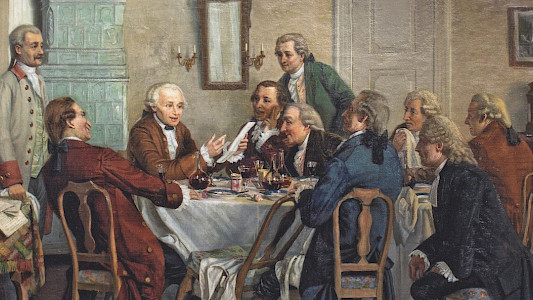
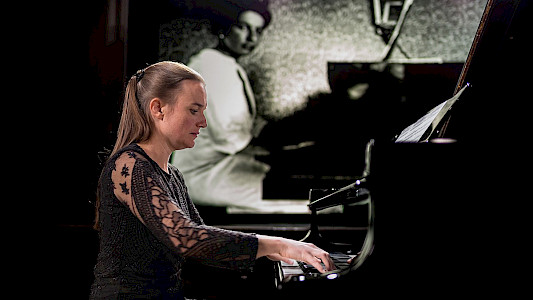
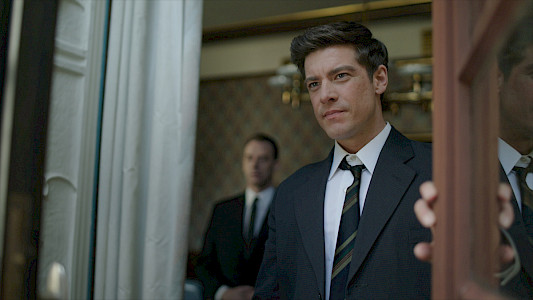
The highly talented composer Johannes Brahms was a close friend of Clara and Robert Schumann. His work is often put on a par with Beethoven’s. This docudrama paints a vivid picture of his musical pursuits and private life. When Johannes Brahms was born in Hamburg in 1833, no one could have known that he would one day be a child prodigy who would leave a lasting mark on music history. In the opinion of international music critics, the grandiose symphonic power of his music, the richness of his themes and the concentrated form of his symphonies are on a par with Beethoven’s greatest works. And yet Brahms suffered from melancholy throughout his life and is thus often regarded as a solitary, tragic genius. What influenced and inspired him? Who was it that triggered such complex emotions, which he then expressed in his musical masterpieces? The women in his life certainly sparked his creativity. In particular his friendship – or, better said, his deep, unfulfilled love – for the famous but much older pianist Clara Schumann would accompany him throughout his lifetime. Although Brahms ended up putting his art before his love life, one can feel his anguished devotion to Clara in his music – music that still today inspires writers, filmmakers and musicians the world over. The docudrama takes us back to the nineteenth century to immerse us in the life and career of the highly talented composer and combines dramatic re-enactments with documentary sequences, painting a vivid picture of Brahms’s musical pursuits and private life.

Johannes Brahms – The Solitary Genius

STANDING IN FRONT OF MANY HOUSES

Germany 2020, 68 min
by Ekaterina Reinbold

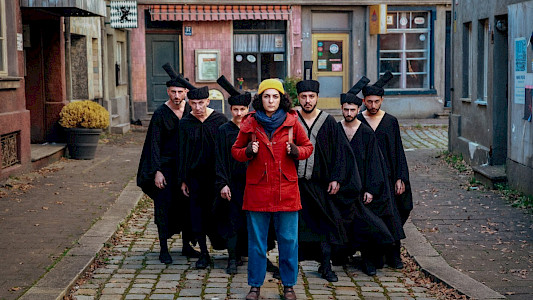
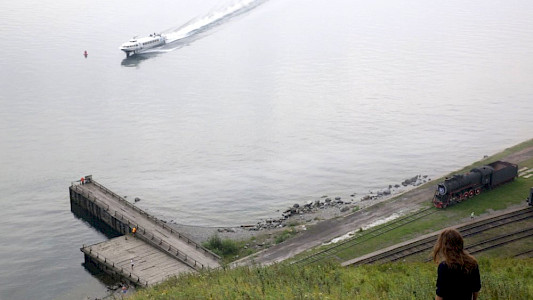
The movie где остался домовой / STANDING IN FRONT OF MANY HOUSES has two titles. The literal translation from Russian is .Where did the Domovoi go?. and refers to an old Slavic popular belief. Hence the house spirit, the Domovoi, ensures the protection and peace of a place. The English title plays with the impossibility of a direct translation of this figure and describes through the vivid STANDING IN FRONT OF MANY HOUSES the feeling of being lost in a diasporic experience. где остался домовой / STANDING IN FRONT OF MANY HOUSES plays at the intersection between fiction and documentary film and shows the return of the young woman Natasha to a former home at the coast of Lake Baikal in southwestern Siberia. Her friend Katya accompanies Natasha on her journey with a handheld camera that captures the events.After the collapse of the Soviet Union, Natasha immigrates as a child with her family to Germany. The film begins today, twenty years later, when Natasha returns for the first time to her unknown home. Natasha's time in Baikal Port is mainly structured through her everyday encounters with the people who live there. In different situations, she meets them and gets into conversations about employment and living conditions that are still marked by the effects of the Perestroika. While Natasha gains these intimate insights into different ways of living, she reflects on her own position and tries to make a connection with this place, which is a part of her identity. The cinematic drawing of intimate portraits of people living in Baikal Port as well as Natasha’s play- acting as a returning, identity-seeking figure is accompanied by an ever-present recording camera. It shakes, zooms and focuses, it behaves like an autonomous body. This always raises the question of who is the actual experiencing body of this journey – the person behind or in front of the camera?.

Standing in Front of Many Houses

THE MOLE AGENT

Chile, USA, Germany, Netherlands, Spain 2020, 84 min
by Maite Alberdi

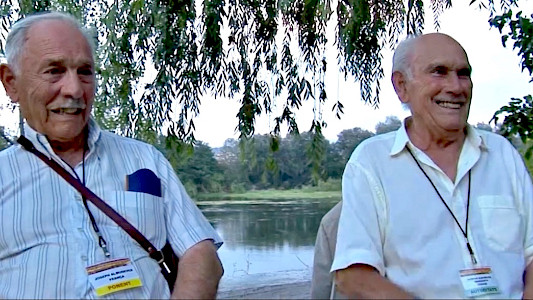
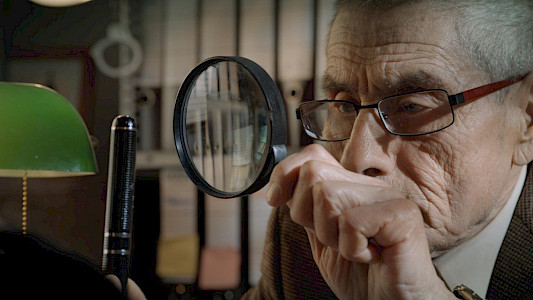
When a family becomes concerned about their mother’s wellbeing in a retirement home, private investigator Romulo hires Sergio, an 83 year-old man who becomes a new resident–and a mole inside the home, who struggles to balance his assignment with becoming increasingly involved in the lives of several residents.Sergio is a Chilean spy. Sort of. At least, he is offered the role of one after a casting session organized by Detective Romulo, a private investigator who needs a credible mole to infiltrate a retirement home. Romulo’s client, the concerned daughter of a resident, suspects her mother is being abused and hires him to find out what is really happening.However, Sergio is 83, not 007, and not an easy trainee when it comes to technology and spying techniques. But he is a keen student, looking for ways to distract himself after recently losing his wife. What could be a better distraction than some undercover spy action? While gathering intelligence, Sergio grows close to several residents and realizes that the menacing truth beneath the surface is not what anyone had suspected.Maite Alberdi’s The Mole Agent is a stylish combination of an observational documentary and a spy movie, with sleek camerawork and wonderfully watchable characters. It’s a unique meditation on compassion and loneliness that will infiltrate your heart and never let go."The most heart-warming spy movie ever made...delightful" - IndiewireProduction companies:Tribeca Film Institute, Sundance Institute, ITVS, Micromundo Productions, Motto Pictures, Sutor Kolonko, Voyla Films, Malvalanda, SWR

The Mole Agent

THE NEW GOSPEL

Germany, Switzerland 2020, 107 min
by Milo Rau

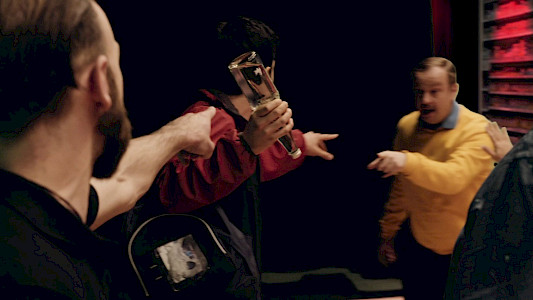
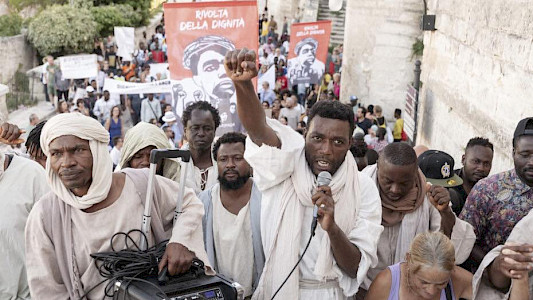
What would Jesus preach in the 21st century? Who would his disciples be? And how would today’s bearers of secular and spiritual power respond to the return and provocations of the most influential prophet and social revolutionary in human history? With “The New Gospel”, Milo Rau is staging a “Revolt of Dignity”. Led by political activist Yvan Sagnet, the movement is fighting for the rights of migrants who came to Europe across the Mediterranean to be enslaved on the tomato fields in southern Italy and to live in ghettos under inhumane conditions. The director and his team return to the origins of the gospel and stage it as a passion play of an entire civilization. In Matera, in southern Italy, where the great Jesus films from Pasolini to Gibson were shot, an authentically political as well as theatrical and cinematic “New Gospel” emerges for the 21st century. A manifesto of solidarity with the poorest, a revolt for a more just, humane world.A production of Fruitmarket, Langfilm & IIPM – International Institute of Political Murder in coproduction with SRF Schweizer Radio und Fernsehen / SRG SSR, ZDF in cooperation with ARTE in collaboration with Fondazione Matera Basilicata 2019, Consorzio Teatri Uniti di Basilicata and Teatro di Roma supported by Film- und Medienstiftung NRW, Bundesamt für Kultur (BAK), Zürcher Filmstiftung, DFFF - Deutscher Filmförderfonds, Kanton St.Gallen Kulturförderung / Swisslos, BKM - Die Beauftragte der Bundesregierung für Kultur und Medien, Volkart Stiftung, Suissimage Kulturfonds

The New Gospel

AGAIN

Germany 2019, 39 min
by Mario Pfeifer

In the Saxon village of Arnsdorf, an argument between a supermarket cashier and a Kurdish-Iraqi refugee escalates when four men drag the latter outside and tie him to a tree. The police arrive 25 minutes later. AGAIN reenacts the incident, the subsequent trial and investigates the refugee's ordeal. Ten citizens observe and comment on the case, which highlights the blurred distinction between civil courage and vigilante justice.We would recommend Again/Noch Einmal receive a Special Mention. The film was sophisticated in its structure and ambitious in its realisation. Again was also challenging, taking on a fraught issue preoccupying many communities and countries worldwide, one that is not black and white. In setting up its audiences as active spectators, it eschews simple empathy, rather forcing us to engage with our own ethical and political viewpoints. ( Jury Statement for Special Mention, 14 Doc Edge in Neuseeland9'His name was Schabas Saleh Al-Aziz. He came from Iraq where his family had remained. He was 21 years old. He suffered from epilepsy and mental disorders and he was found frozen to death in a forest in former East Germany. Some time before his death, he had been the subject of an intense debate when, during a violent incident in a supermarket, he had found himself tied to a tree by four men—heroes to some, self-appointed vigilantes fuelled by racism to others. This is the event that Mario Pfeifer proposes to re-enact in a studio, down to the smallest detail. Applying the codes of the TV talk-show, action films or even legal staging, he lets everyone speak, using film as the means to hold a trial that never took place, since the judge handling the case refused to investigate it. A jury needed to be composed—ten men and women with only one thing in common; they too left their country to settle in Germany. An essential, contemporary film of unrelenting precision.' (Visions du Réel, Céline Guénot)

Again