
Germany 2020, 110 minby Marc Bauder
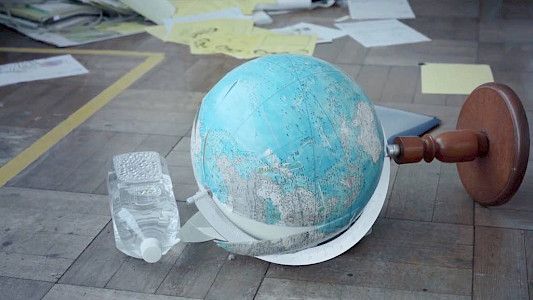
A cinematic essay - inspired by the book "who we were" by Roger Willemsen We may think that we're simply not capable of understanding the increasingly complex problems of our planet, but for these charismatic scientists, that's not enough. Whether it's on the top of the world, in the depths of the ocean, inside the human brain, at the G-20 summit, or in the heart of the International Space Station ISS, they are searching for practical ways to save our world. Considering their drive, we have to ask ourselves if, we as citizens of the planet, are finally ready to take on responsibility – if only for the sake of those who will come after us and ask: "WHO WE WERE"? With Alexander Gerst (astronaut), Sylvia Earle (deep sea researcher), Mathieu Ricard (buddhist monk), Dennis Snower (economist), Felwine Sarr (philosopher) und Janina Loh (critical post- humanist).
WHO WE WERE
Switzerland, Germany 2018, 97 minby Barbara Miller
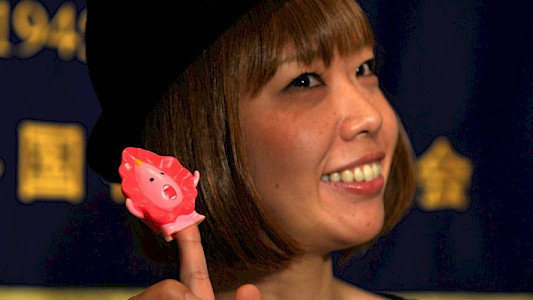
#FEMALE PLEASURE embarks on a journey to discover the remaining obstacles that stand in the way of female sexuality in the 21st century. In the context of the world religions, courageous women break their silence regarding one of the greatest mysteries and taboos of our time: female pleasure.The film spans the globe to accompany five extraordinary women, revealing their successful battle for a relaxed and balanced relationship between women and men, as well as for self-determined and fulfilling sexuality. (CAT&Docs)Women are subordinate to men. They are born sinful and have no legal claim to their own body. Misogyny is more than a phenomenon observed across continental divides all over the world and in some cases the cause of abuse and crime. It is structurally inscribed – literally – into the core of all social systems founded on religious beliefs. In the bible, for example, we read: “I find woman more bitter than Death […] The man who is pleasing to God eludes her.”In this lucid film, which takes a global perspective, five female protagonists talk about misogynistic behaviour they experienced, hostilities they were exposed to, crimes committed against them. Rokudenashiko, a Japanese artist, is on trial for the obscenity of her art. Deborah Feldman escaped with her son from a Hassidic community in Brooklyn, leaving her husband to whom she was forcibly married. Leyla Hussein, Doris Wagner and Vithika Yadav talk about rape and mutilation, lack of legal protection, homophobia, shame and the strange feeling that one’s sexuality and body are associated with sin from birth. (DOK Leipzig, Lukas Stern)
#Female Pleasure
2014, 94 minby Regina Schilling
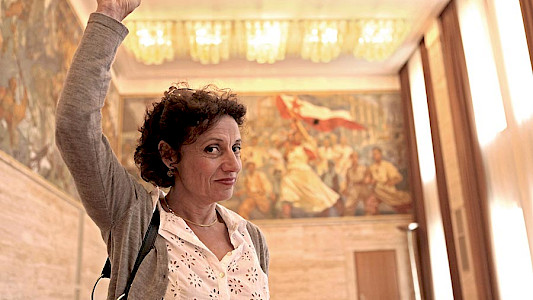
Portrait of actress, author and director Adriana Altaras. Adriana Altaras is a director, actress and writer. And she is from a country which no longer exists: Yugoslavia. The daughter of Jewish partisans who fought for Tito and later started a new life in post-war Germany, in this lovely film she tells the story of her ’high maintenance family’. Adriana’s domestic situation appears unusual at first glance, but can be seen as typical of the generation born after the War. Despite a high standard of living, the wounds from her parents’ past can be felt, even to this day, and the search for her own roots are her constant companion.
TITO’S GLASSES
Germany 2011, 80 minby Katja Dringenberg, Christiane Voss
What happens to us after death? Through whose hands do our bodies pass, before they vanish from this world once and for all? ENDLICH / AT LAST - LIVING WITH THE DEAD seeks out the mysterious places that the dead pass through. In this shadow realm, it is the service providers for the dead that rule, the carers and the disposal experts. Our journey leads us from the Berlin Crematorium to a eulogist, who presents a final image of the deceased that befits them and that provides some comfort for those left behind. We hear a eulogy in an empty church, which - apart from us - only the deceased seems to hear and defies their being forgotten. We discover how the living can make contact with the dead, first of all at an emotionally charged calling of the ancestors conducted as part of a family constellation. Then, with its poetic, yet disturbing performances, a choir makes the voices of the dead audible. It invokes the mercilessness of death, making it tangible, and voices our fear of it. ENDLICH / AT LAST - LIVING WITH THE DEAD takes us to places never seen before and leads us into a fascinating and previously hidden world. World Sales by: DOC & FILM INTERNATIONAL 13, rue Portefoin, 75003 Paris FRANCE Fon : +33 (0) 1 42 77 56 87 Fax : +33 (0) 1 42 77 36 56 doc@docandfilm.com http://www.docandfilm.com
AT LAST - LIVING WITH THE DEAD
Germany 2005, 167 minby Philip Gröning
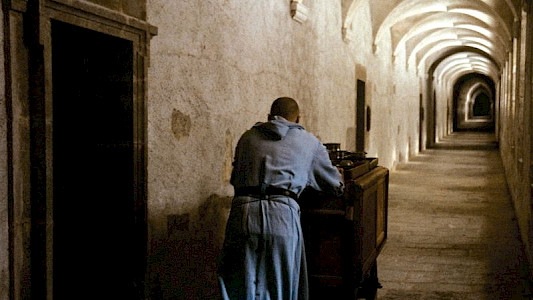
Silence at the movies pays, and that profound and engrossing variety of German documentary Into Great Silence (Die Grosse Stille), by Philip Groening (who produced the film with Bavaria Film and Swiss company Ventura Films), won the hearts of jury members of the World Cinema Documentary Section at the Sundance Festival, who bestowed upon it a Special Jury Prize.(Camillo De Marco / Cineuropa)Deep in the French Alps lies La Grande Chartreuse, one of the world’s most ascetic monasteries. In 1984, the German filmmaker Philip Gröning wrote to the Carthusian religious order requesting permission to shoot a documentary about them. They wrote him back saying they needed to think about it. Sixteen years later they gave their approval, in a unique gesture by this monastery that otherwise never admits outsiders. For six months Gröning lived among the monks, filming their daily prayers, chores, rituals and rare visits outdoors. He used neither crew nor artificial lighting, and there's no musical soundtrack or voice-over. The monks spend 18 hours each day in silence; living in silence and solitude brings them as close as possible to God. This observational film offers a thorough immersion into transcendental monastic life. In the silence, all that remains is elemental: time, space and light. More than a documentary, Gröning’s masterpiece is a meditation, a film about consciousness and absolute presence. This is cinema at its purest. (IDFA 2017)
Into Great Silence
Bitte aktivieren Sie Javascript, um auf unsere Website zugreifen zu können.