Germany 2024, 91 minby René Frölke
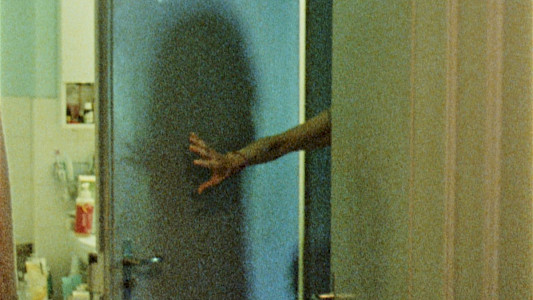
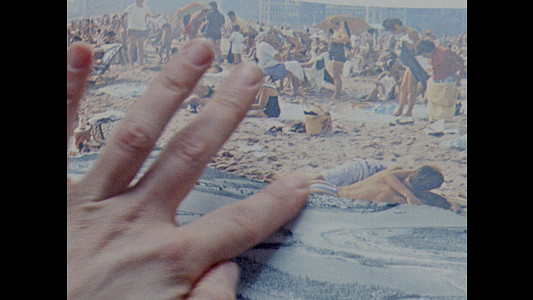
Twenty years after Swiss publishing house Pendo closed its doors, the descendants of its founders repeatedly circle, examine and lose sight of its legacy. Frölke’s film gives structure to this archive via media experimentation.The film gives brief glimpses into rooms bathed in light. The Bolex camera whirs. Twenty years after the closure of Swiss publishing house Pendo, which was founded in 1971, its story is revealed by way of personification: heir Theresia Weigner and her partner, who repeatedly circle, examine and lose sight again of this legacy with all the weight it carries. Here articles of memory are piled high, cared for, stashed away. Remaining stock, no longer hot off the press, but still packaged up for sale, unfinished manuscripts, cover designs, cassettes, office supplies, correspondence and tax documents are all laid out like in a time capsule: books by Margarete Mitscherlich, Dorothee Sölle, Dom Hélder Câmara, illustrated volumes about Robert Lax or the Sihl Valley. René Frölke’s film gives a structure to this archive and becomes a simple chamber of wonders. He finds his own annotations within the inner pull exerted by the artefacts and accompanies these stubborn, overwhelmed preservers on their way through their everyday life amid the piles of material. Written elements from the film script also play a part.At the end of the corridor, jazz music sounds from a small radio. [74 BERLINALE Forum]
Traces of Movement before the Ice
Germany 2023, 25 minby Ann Carolin Renninger
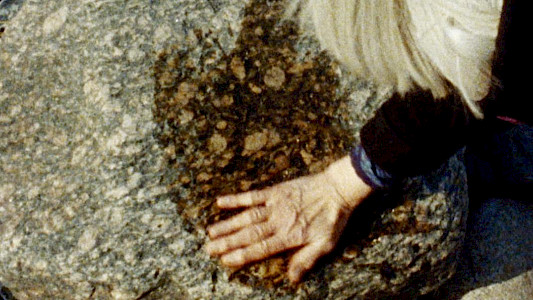
It is a stroke of luck when a film manages to simply observe the flow of life and almost casually show us the miracles found in life’s corners. Ann Carolin Renninger approaches people and things with great serenity and a palpable joy of searching for and finding images.Rovin lives on a remote farm on the Baltic Sea and explores his surroundings with insatiable curiosity. He is interested in the universe, planets, unknown creatures – and in tardigrades, those tiny multicellular organisms that look like dust bags on legs and are real survival artists. Quite unlike humans, as Rovin points out, because the latter are sure to die out one day. He sees this as a logical fact, not a threat. And when you open yourself up to the grainy, earthy images and the calm narrative, you eventually stop wondering, too, why that should be a problem. After all, as long as the wind blows through the trees and scatters the tardigrades, everything is in good order. In addition to the captivatingly alert boy, Renninger meets Marie, who knows everything about rocks, and Christopher, who decorates a place with these rocks. They are all on a quest and every day find a piece of what one cannot hold onto: the present. [66DOK Leipzig, Luc-Carolin Ziemann]
The Wind Is Taking Them
2017, 83 minby Ann Carolin Renninger, René Frölke
Willi is nearly 90 years old and lives alone on a farm in northern Germany. He likes to talk to his cat, he feeds his chickens and makes his rounds with the aid of a squeaky walker. The garden is overgrown. His house is full of all the things that have accumulated there over the course of a long life, relics of bygone times. Occasionally someone comes to visit, or a moped passes by, but not much happens otherwise. As the seasons change, the film paints a portrait of the everyday life of this resolute, slightly dishevelled old man. It’s also a visual essay on the cycle of life, as the camera observes nature, captures fruit and flowers in bloom in all their glory. Textures equally come to the fore: the cat’s fur, the pattern on the coffee service, the structure of a marzipan cake; at times the camera photographs apples or plastic garden chairs as if they were still lifes. The images transcend mere depiction – they contain a feeling of evanescence, which is enhanced by the fragility of the Super-8 and 16-mm material used to film them. Even the black screens that appear when the reels are changed reveal the passage of time.
From a Year of Non-Events
Germany, France, Italy 2017, 52 minby Anna Marziano
Through a selection of excerpts from music, film and literature, the film opens a conversation that crosses the labyrinth of domestic violence and pain caused by ideals or circumstances. It deals with different attempts of living together, of nourishing connections towards people who passed away, in a wide reflection on our singular/plural condition. Not a film on family, couple, community nor polyamory. Rather traces of an act of existence. Film stock like fossil fragments. Sounds keeping suggestions of meetings with people and moments. Conversation in which essay and poetry intertwine, wandering the blurred area where our solitary beings merge and the ambiguity of our intimate relational life begins.in coproduction with Spectre and Anna Marziano, funded by CNC in collaboration with Goethe Institut Max Mueller Bhavan, bangaloResidency, Experimenta India.
Beyond the One
Germany 2014, 100 minby René Frölke
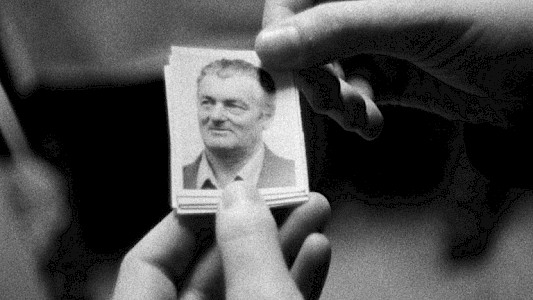
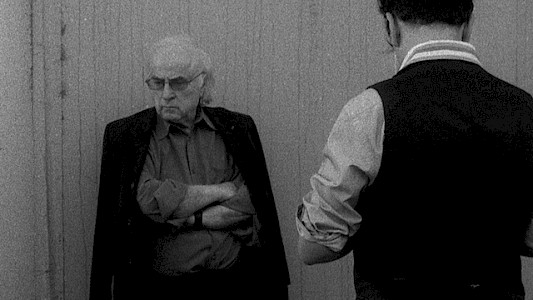
Le beau danger is a cinematic arrangment between documentary portrait and literary text. Interwoven with the moving image and divided into one hundred and seventy black and white text screens we read the work of the Romanian author Norman Manea. It is the attempt to have image and text question eachother and respond to eachother. Arising from the observation of the present of the author, which is also our present, the inner conflict of our time becomes visible, a conflict in which information becomes the counterpart of experience and therefore also of the memory itself.
Le beau danger
Germany, France 2013, 60 minby Marta Popivoda
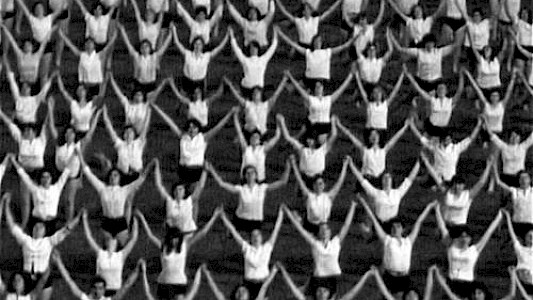
The film deals with the question of how ideology performed itself in public space through mass performances. The author collected and analyzed film and video footage from the period of Yugoslavia (1945–2000), focusing on state performances as well as counter-manifestations. Here, however, documentary images are not taken only as historical facts, but are instead reflected on by a voiceover which tells a story of Yugoslavia’s recent history, struggling with memory, media images, and personal experiences. The film thereby reconstructs how the social system changed from socialist Yugoslavia to neoliberal capitalist Serbia, and how the changes have been historicized through a theatre of history.Production:Universität der Künste Berlin, BerlinLes Laboratoires d'Aubervilliers, ParisTkH [Walking Theory], BelgradeCo-Production:joon film, Berlin
Yugoslavia, How Ideology Moved our Collective Body
Germany, Italy 2012, 23 minby Lorenzo Castore, Adam Cohen
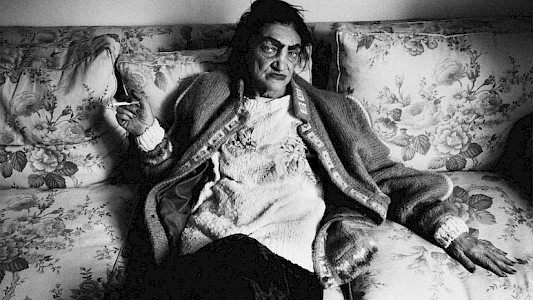
NO PEACE WITHOUT WAR is a film about Ewa and Piotr Sosnowski, brother and sister, living together since the death of their father. It is meant to be the story of a forgotten world that takes place behind the door of a tworoom apartment in Krakow, Poland. Comprehending Ewa and Piotr‘s past and present simply through facts is almost impossible. At a certain moment everything falls into a misty and mysterious cloud where real and invented memories become indistinct. The more we get to know them facts become trifling and unsubstantial. The only sure thing is that they live in extreme poverty but they never complain about it. Insight and unique access to this story is made possible through the eyes and understanding of Italian photographer-filmmaker Lorenzo Castore (Mario Giacomelli Prize 2003, Leica European Publisher Award 2005) and the visual approach of experimental documentary filmmaker Adam Cohen. In collaboration with Austrian composer and guitarist Christian Fennesz.
NO PEACE WITHOUT WAR
Germany 2011by René Frölke
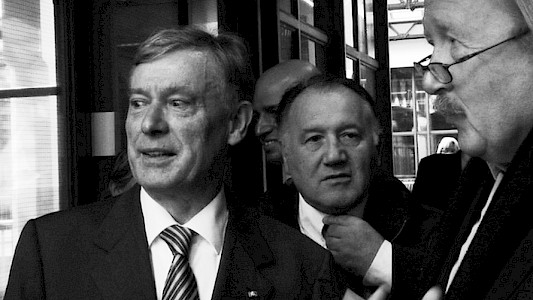
What’s in this movie? It is but a small sequence – a 37minute excerpt of an encounter. A universal event: The statesman, the representative, the dignitary meets a group of representatives. There is talk of the arts and repeatedly of economy. It is also the attempt at communication under pressure. All those involved appear somewhat tense. Details are getting lost, simplifications occur. But underneath the rubble heap of text the movements of our time, our epoch become visible. Maybe something that in later days will be allocated as typical or characteristic for this time.
GUIDED TOUR
Germany 2010, 94 minby René Frölke
A film about a young man. His name is Jürgen Stenzel. He paints. An artist who never went to art school. His mother, Edeltraud, recounts a journey that started a long time ago and has etched itself into the story of her life. And Günter, the father, always the silent companion in the background. Father, mother, son. The film feels its way into the lives of these three people. And then it follows the subtle ramifications of their stories. The images arising won't be complete. The portrait of a family, once brought together by coincidence. Their stories tell of families, dreams, traumas, setbacks and determination, allowing our perspective on the three people to change again and again. And just when the picture seems to come into focus, it blurs and is reset. The film is a search for traces, not aspiring to come to a conclusion, but rather seeking to endlessly evolve.
OF THE SALAMANDER'S ESPOUSAL WITH THE GREEN SNAKE
Bitte aktivieren Sie Javascript, um auf unsere Website zugreifen zu können.