
2015, 84 minby Böller und Brot Sigrun Köhler und Wiltrud Baier
Sibylle Berg provokes somehow.Her life story from GDR refugee up to bestselling author sounds mythical. Previously Sibylle Berg searched for good fortune, now she's looking for a house.In this portrait of the great ironic dramatist we learn the male word for 'author', why they often have to hold their heads on author-fotographs, what kind of useful things (like diving under ice) you could learn in GDR, how fungi control the brains of politicians – and that behind every shy author there’s a shy person.With: Sibylle Berg, Katja Riemann, Helene Hegemann, James Goldstein, Olli Schulz
Who's Afraid of Sibylle Berg
France, Germany 2006, 86 minby Jürgen Ellinghaus, Hubert Ferry
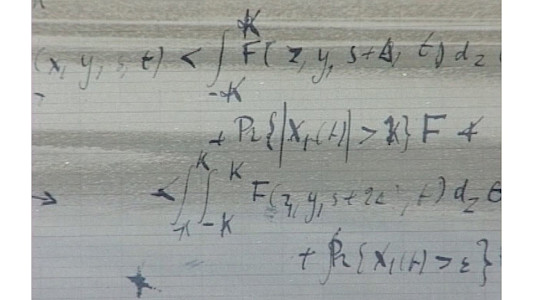
When France surrendered in 1940 and German soldiers showed up in the small village of Housseras (Vosges, Région Grand Est, Northeast of France), an unknown French infantryman burned his papers and killed himself in a farmer's barn. Four years later he was identified as "soldat Doblin, Vincent". In fact, he was none other than the mathematician Wolfgang Doeblin, son of the famous German novelist Alfred Döblin ("Berlin Alexanderplatz") who was forced to flee Germany with his family in 1933 because of his resolutely anti-Nazi positions and Jewish descent.A French citizen since October 1936, Wolfgang Doeblin carried on his research in Probability Theory during his military service and even during the hardships of the "Phoney War" in the winter of 1939-40. In February 1940, four months before his death at the age of 25, he sent his most important manuscripts ("About Kolmogorov's Equation") in a sealed envelope to the Academy of Sciences in Paris, where they were kept in safe custody for 60 years.Wolfgang Doeblin's short and dramatic life story, almost forgotten, was finally brought into the limelight when the sealed envelope was opened in May 2000. Far ahead of their time, his groundbreaking contributions to the theory of random processes place Wolfgang Doeblin among the major innovators of probability, the "mathematics of randomness". Mathematical models for evaluation of chances and risks went on to gain major importance in vast domains of modern science, in everyday life and especially in the contemporary financial mathematics and its numerous applications in capitalist economies.
The Last Equation of Private Doblin
Germany, France, USA 2015, 88 minby Thorsten Schütte
It is only fitting that a comet and a mollusk are named in Frank Zappa’s honor. The famed American musician, composer, and thinker created satirical, operatic interpretations of music that seemed to originate from another world.Thorsten Schütte’s film is a sharply edited and energetic celebration of Zappa through his public persona, allowing us to witness his shifting relationship with audiences. Utilizing potent TV interviews and many forgotten performances from his 30-year career, we are immersed into the musician’s world while experiencing two distinct facets of his complex character. At once Zappa was both a charismatic composer who reveled in the joy of performing and, in the next moment, a fiercely intelligent and brutally honest interviewee whose convictions only got stronger as his career ascended.Zappa was uncompromising as he led the charge against music censorship in the ’90s and even went on to embrace the role of quasi-cultural ambassador in the Czech Republic. His music and ideas are vital, and they cut across generations, while his goal of freeing the listener from conformity still resonates today. (Sundance)
EAT THAT QUESTION
Germany 2013, 105 minby Susann Reck
Blender is an autobiographically inspired documentary. The title stands for a 1100 meter high mountain at the foothills of the Alps, where my parents founded an open home for the mentally ill and gave it the name of the mountain, BLENDER. The film documents the period of a year. Why did four of the six protagonists have to leave the home during shooting? This question is also connected to my childhood, where patients were coming and going all the time. Of course the reasons for it are understandable: Disappearing from the Blender is often associated with alcohol, violence, death and schizophrenia. The film is an ensemble film and the episodes revolve around the comings and goings of the patients. The episodes are introduced in a light, almost serene way and condense as the film progresses to grief and drama. The protagonists themselves are appealingly direct and natural. They are aware of their situations and act out of their own inner logic. BLENDER is not primarily about craziness or being different. Against an impressive natural backdrop the film follows diverse forms of human existence following their lonely paths through life.
BLENDER
Germany, Polen 2012, 85 minby Michal Marczak
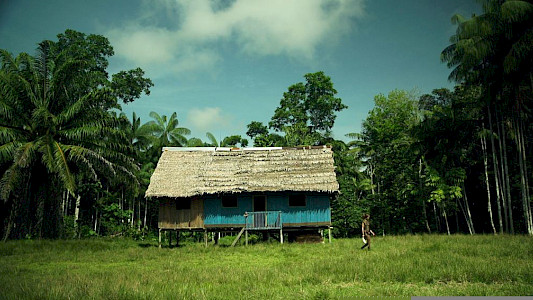
Berlin’s Fuck For Forest is one of the world’s most bizarre charities.Based on the idea that sex can save the world, the NGO raises money for their environmental cause by selling homemade erotic films on the internet. Meet Danny, a troubled soul, as he accidentally discovers this exuberant, neo-hippy world where sexual liberation merges with global altruism, and joins their already colourful operation. From the streets of Berlin to the depths of the Amazon, together they are on a planet-saving mission to buy a piece of forest and save the indigenous peoples from the sick, sick West.
F*CK FOR FOREST
Germany 2011, 97 minby Corinna Belz
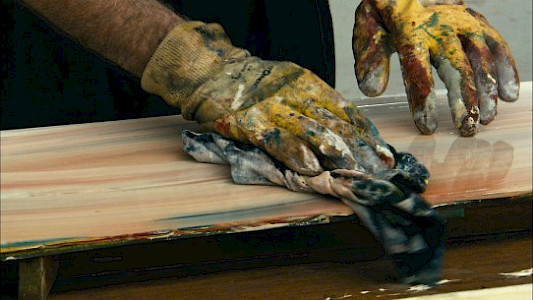
Gerhard Richter, one of the internationally most significant contemporary artists, granted filmmaker Corinna Belz access to his studio in 2009 where he was working on a series of large abstract paintings. GERHARD RICHTER PAINTING offers us rare insights into the artist’s work. In quiet, highly concentrated images, the film gives us a fly-on-the-wall perspective of a very personal, tension-filled process of artistic creation. We see Richter painting. We see him observe and dialogue with his paintings. We see him contemplate, wait, reject, rework and sometimes destroy only to begin anew. Our perceptions expand. The paintings themselves become the protagonists. GERHARD RICHTER PAINTING is the penetrating portrait of an artist at work – and a fascinating film about the art of seeing.
GERHARD RICHTER PAINTING
Germany 2009, 96 minby Hans-Christian Schmid
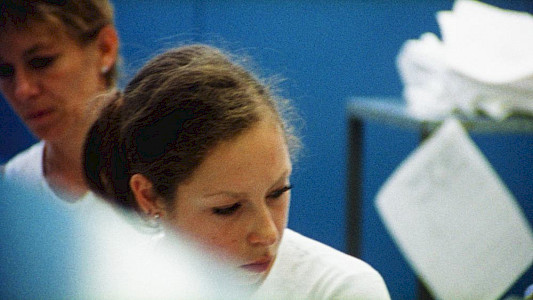
Behind the fluffy towels and crisp white sheets of Berlin's finest hotels belies a tale of brilliant entrepreneurship: A company takes the dirty laundry of the German hotels to Poland and brings it back clean the very next day. Outside of Germany, labour is cheaper and regulations are less constricting. But farbeyond this fascinating capital venture remains the harsh realityof everyday life of the hard-working Polish workers, throughwhose hands the white sheets pass. While Beata struggles toraise her three children on her meager salary, the more mature Monika reminisces about her unrealizedchildhood dreams of becoming a doctor, compelled to watch her teenage daughter Marta graduallyfollow in her footsteps.
THE WOUNDEROUS WORLD OF LAUNDRY
Germany 2008, 92 minby Niels-Christian Bolbrinker, Dr. Kerstin Stutterheim
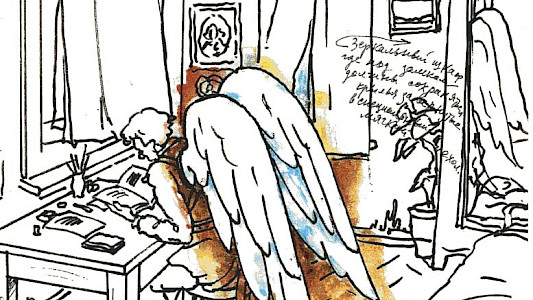
Ilya Kabakov was born in the Ukraine in 1933. Today he is considered one of the most important contemporary artists worldwide, and there is practically no significant museum of contemporary art around the world that doesn't show at least one of his installations. With his etchings, paintings and particularly with these installations he has for decades now created a phantastic world that serves as a counterpoint to the brutal reality and its many failed visions. These installations, executed with exquisite detail, are strange and enchanted spaces. They are like film sets telling life histories, touching emotions and memories held by people everywhere. But his stories are more than personal dramas: Kabakov is one of the last great utopists, he looks disenchantedly at the debris of the 20th century but at the same time, with human warmth and a distinct imagination, he is able to envision other worlds.
FLIES AND ANGELS
Germany 1991, 81 minby Andres Veiel
In the end of the 20s Inca Köhler-Rechnitz concludes her theatrical education. She fancies with a role from the summer night dream in the Görlitzer municipal theatre - and receives immediately an offer. However, days before the beginning of the first playing time her husband refuses the then necessary approval. In the 30s it is threatened as a half Jew before the deportation in a concentration camp.Only 60 years later she stands with the old amateur dramatic society DIE HERZSCHRITTMACHER for the first time in Berlin on the stage. Andre Veiel writes a piece for them with which they should appear in the Görlitzer Stadttheater.
WINTERNACHTSTRAUM
Bitte aktivieren Sie Javascript, um auf unsere Website zugreifen zu können.