Germany 2024, 111 minby Katharina Pethke
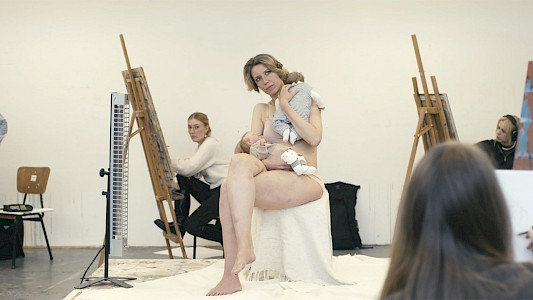
The ensemble of buildings that makes up the maternity clinic and art school in Hamburg where the director taught is the starting point for this sober interrogation of how motherhood and career can be combined based on three generations of German women.How much does a place reveal about its history? How much can forbears and their descendants know about one another? And how much continuity is contained within progress? When Katharina Pethke became a professor at Hamburg’s University of Fine Arts, it set in motion a process of reflection and research. Before, she had studied there, and so too had her mother and grandmother. Each of the women believed they were breaking new ground and yet, consciously or unconsciously, through stance or in protest, continued to carry on a legacy. This essay film examines the three generations caught between social determination and artistic ambition, self-will and motherhood, production and reproduction. The university building and its sole sculpture by a woman artist purchased by urban planner Fritz Schumacher, “Frauenschicksal” (Women’s Fate), become a mirror as well as showcase for enduring ambivalences. A virtuosic and astute work from an established filmmaker, Reproduktion explores questions of feminine and artistic identity through the lens of Pethke’s personal experience, interweaving her family biography with the architectural history of the art and media campus. [74 BERLINALE – Forum]
Reproduction
Germany 2023, 94 minby Andre Siegers
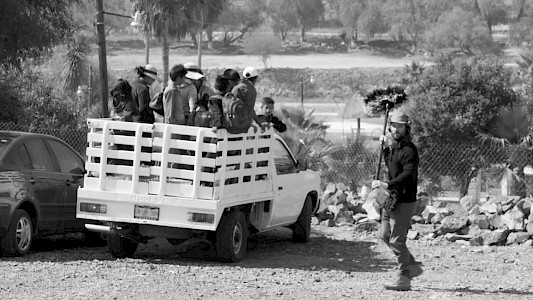
In search of a story, a German film team finds itself in the Mexican village of El Alberto. The so-called Caminata Nocturna has made the small community famous. A tourist attraction based on the experiences of the villagers that re-enacts the illegal border crossing into the United States. What once started as a performance to make the local youth aware of the dangers of illegal migration has now become one of the village's main sources of income. Netflix visited. Italian, Japanese, Austrian and other productions, too. And now the Germans. While around them the village unflinchingly goes about its business, claims rights to its own image and subject, supplying border patrols, dangers and reenactments in a lucrative capital barter, their stay develops into an unintended exploration of the possibilities and limitations of cinematic representation.
LA EMPRESA
Germany 2020, 49 minby Karsten Krause
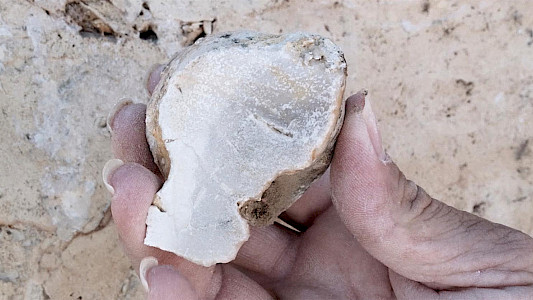
Spaces expand or disappear. Oceans become deserts. Rock erodes to sand and dust and human kind is passing by all this. Since the beginning of our existence, we are constantly moving from one place to another, fleeing hunger, war or the forces of nature, but also driven by a sense of longing for change. AT THE BOTTOM OF THE SEA traces forms of migration, interweaving them with geological and archaeological cartographies. In magical tableaux, the film draws a cinegraphic melancholy where a border fence is not even useful for a comma on earth's timeline.
At the Bottom of the Sea
Germany 2019, 154 minby Bernd Schoch
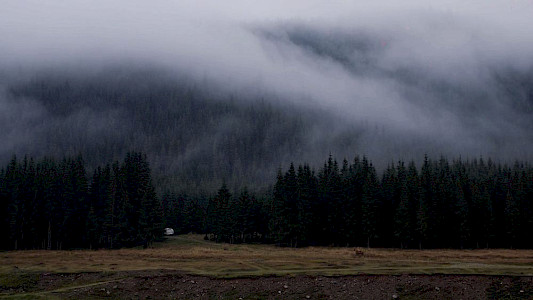
A sprawling mycelium. The starry sky over the Romanian Carpathians. The first two images introduce the dimensions that are at the core of Olanda: Details and fine structures on the one hand, constellations and the bigger picture on the other. The focus is on a seasonal asset of the area - the mushroom. Amongst people it is the foragers who are nearest to them and the focus of the film is on them: on walks through the forest, in the tent camp, during car rides and conversations. From here it follows the rhizome-like ramifications that continue to branch out in the form of money: to local and international merchants, to an impromptu shoe market in a clearing, to gambling among colleagues. The film tells of these trading cycles by assuming a mushroom-like structure without ever losing its centre of thought. Beyond an analysis of economic structures, however, it is also the sensual document of a rhythm of everyday life in the forest, as experienced by foragers as the first link in the recycling chain. In the cinema, it can be experienced as an audiovisual mushroom-trip into the magical world of the Carpathian forests.
Olanda
Germany 2021, 65 minby Katharina Pethke
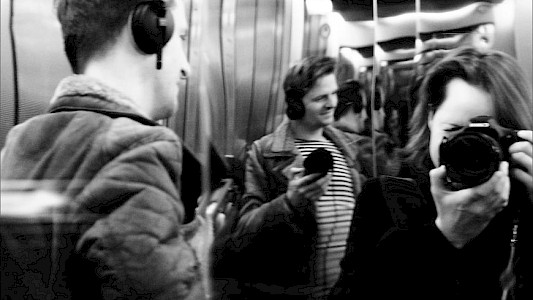
Due to an actor, the life of the documentary filmmaker is thrown into existential turmoil: While for him everything in life is a game, she still firmly believes in reality.When she begins to document their joint encounter, however, the initial fascination is already over: between closeness and distance, the two protagonists sometimes repel, sometimes attract each other.Their triangular relationship with the camera and the sound device resembles a power struggle in the joint struggle for interpretive sovereignty: She wants him to show himself. He takes off his clothes.The naked genius with his self-exhibition pose finally appears to her as the man who is everyone: if he can be everyone, he is at the same time no one. Thus the filmmaker only supposedly fails in her attempt to look behind the mask - because the coat is empty.Fiction appears to her as a last resort.With the passage of time, the director sorts out her different approaches and in the process - partly ironically, partly accusingly - comes to terms with herself. In the process, she relates herself in the montage to other films that deal with the relationship between the showing and the shown: Another distancing strategy?"The magnificent black and white images guide the eye from the surfaces to the details, whose meaning the director probes and questions in her subjective, tentative voiceover. The film preserves the rawness of unfinished reflections without getting mired in vagueness. Step by step, the honest assessment of a desire is achieved; a desire which could function only in the delicate balance between attraction and repulsion and from which Katharina Pethke frees herself by adopting a position of artistic distance. Her sometimes self-mocking commentary is supported by dramatic guitar riffs (provided by Hochmair’s band project “Die Elektrohand Gottes”) and underpinned by filmic references, all of which revolve around the making of images and the relationship between reality and imagination." [Luc-Carolin Ziemann, 64 DOK Leipzig]
Everyman and I
Germany 2019, 84 minby Kate Tessa Lee, Tom Schön
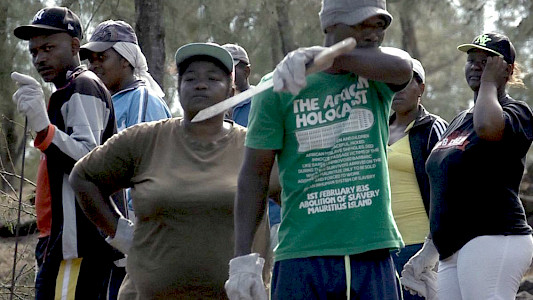
Marie Louise Édouard lives on the island of Rodrigues in the Indian Ocean. She’s stopped diving for octopus, which used to be her livelihood. Ecological influences and changing markets, rules introduced by politicians defining time frames and access. The film focusses on the woman and her everyday life – in concrete absence and yet tangible presence of what used to be at the centre of her life. Other jobs are needed, improvisation is called for. Around her, in her peripheral vision, on the horizon of the peaceful, unhurried pictures of a landscape bathed in light, always in motion, the gap is always perceptible. The global, climate change, the economy, the demise of a tradition are also considered in the film, but are in its form reflected in a concrete experience of time and space, from landscape and everyday life: the film describes above all a being-in-the-world that cannot catch up, a stasis, from which beauty emanates that makes us forget its curse. (17. dokumentarfilmwoche hamburg)
PIQUEUSES
Bitte aktivieren Sie Javascript, um auf unsere Website zugreifen zu können.